갤러리 GALLERY
영등포문화재단
YDPCF
일정 DATES
2026-09-01 — 2026-09-20
위치 LOCATION
서울특별시 영등포구 국회대로 596 영등포구민회관
도시 CITY
서울
전시 소개 ABOUT THE EXHIBITION
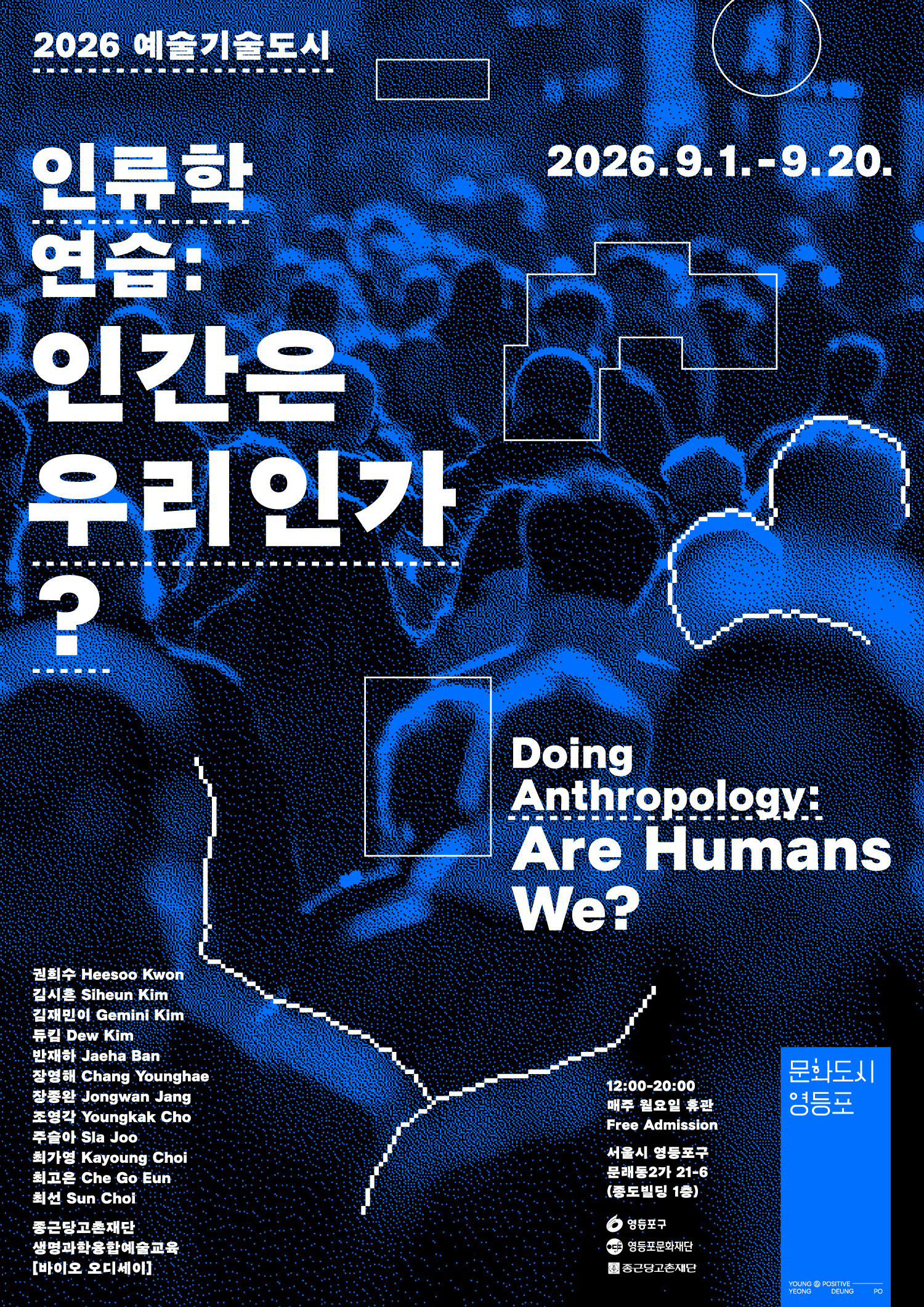
인류학은 낯선 타자를 이해하기 위한 학문으로 시작되었다. 그러나 동시대 예술가들은 탐사의 반경을 타자에 한정하지 않는다. 그들은 자기 자신과 공동체, 비인간적 존재, 그리고 미래적 상상까지를 연구의 장으로 확장하며, 이를 위해 인류학적 관찰과 기록의 방식을 적극적으로 차용한다. 문화인류학의 대표적인 방법론인 민족지(ethnography)는 특정한 시공간의 지정학적 맥락 속에서 공동체의 삶을 가까이 관찰하고, 때로는 그 안에 참여하며 기록하는 실천을 포함한다. 제국주의 시대에 서구가 비서구를 대상으로 발전시켜 온 이 방법론은 오늘날 문명의 전개 방식과 질서가 변화함에 따라 연구 대상과 접근 방식 모두에서 근본적인 전환을 겪고 있다. 가령 지난 세기의 질문인 "인간은 무엇인가"가 진화생물학과 사회과학이 제시한 인간의 정의를 전제로 했다면, 오늘날 "인간은 우리인가?"라는 질문은 그 전제 자체를 흔들며 '우리'의 경계와 질문이 성립하는 조건을 다시 사유하게 만든다.
Anthropology is a discipline dedicated to understanding the unfamiliar Other. Contemporary artists, however, do not limit their field of inquiry to the other. Their explorations extend to themselves, their communities, non-human beings, and imagined futures, drawing on anthropological modes of observation and documentation. Ethnography, which is a widely used methodology in cultural anthropology, involves observing life within a community situated in a particular geopolitical and spatio-temporal context, often through sustained participation and documentation. Developed in the West through the study of the non-West during the colonial era, this method is now undergoing significant shifts in both its objects of inquiry and its modes of engagement, as the conditions and trajectories of contemporary civilization undergo transformation. While the defining question of the previous century — “What is the human?” — presupposed an understanding of humanity grounded in evolutionary biology and the social sciences, today's question — “Are humans we?” — destabilizes these assumptions, compelling us to reconsider both the boundaries of “we” and the conditions under which such a question can be asked.