전시 소개 ABOUT THE EXHIBITION
서울시립미술관은 한국 추상 미술의 선구자 유영국(1916–2002) 탄생 110주년을 기념하여 유영국미술문화재단과 조선일보사와 함께 역대 최대 규모의 회고전 《유영국: 산은 내 안에 있다》를 개최한다. 미공개작을 포함한 회화, 부조, 사진, 드로잉 작품 및 아카이브 170여 점을 통해 그의 예술을 총체적으로 조망한다. 특히 이번 전시는 서울시립미술관이 새롭게 선보이는 ‘한국 근대 거장전’ 시리즈의 첫 프로젝트로, 이를 통해 한국 근대 미술이 이룩한 성취를 오늘의 시점으로 새롭게 연결하고자 한다. 그 첫 번째 작가로 유영국은 일제 강점기와 한국 전쟁, 민주화와 경제의 압축 성장 같은 한국 근현대사를 관통하면서도 추상 미술이라는 당대의 아방가르드 예술을 삶과 작품으로 올곧이 실천했던 작가이다.
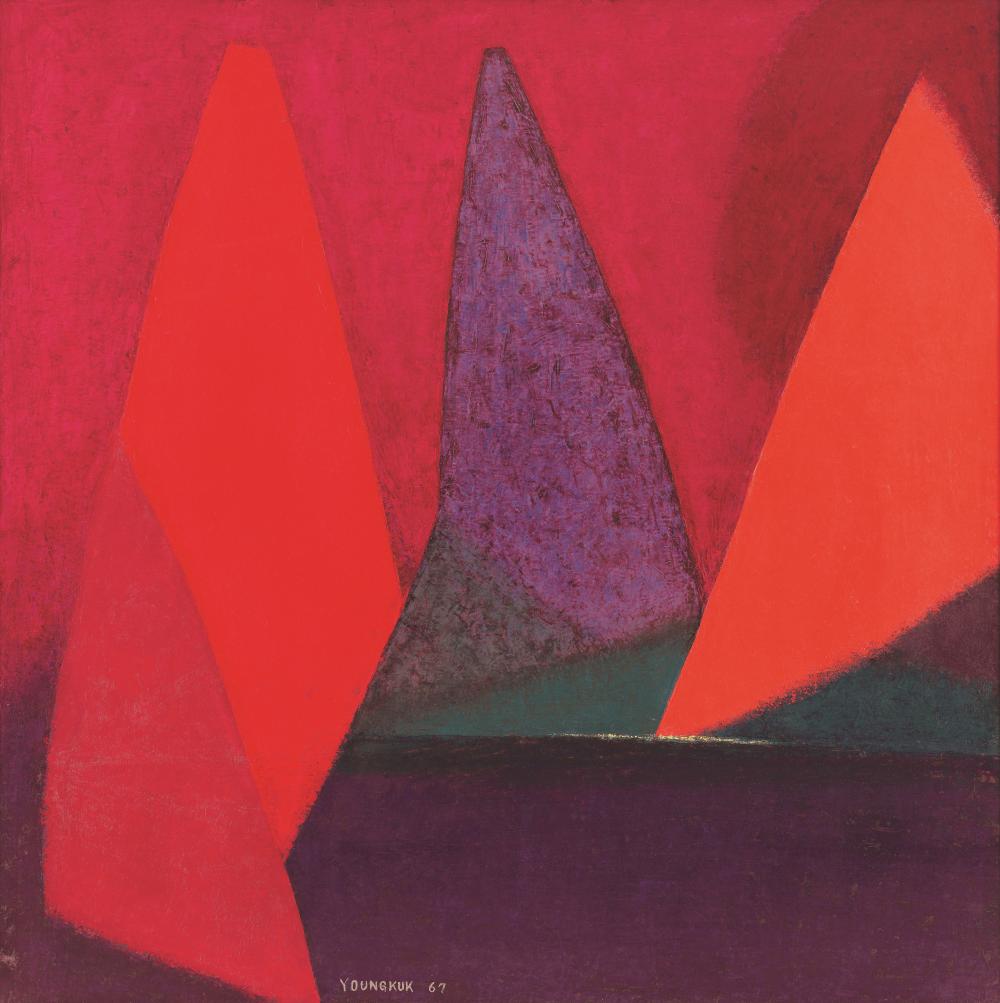
이번 전시는 1935년 도쿄 문화학원에서 시작된 추상 미술에 대한 실험부터 생애 후반 심상 추상에 이르기까지 60여 년의 유영국 화업을 총체적으로 조명한다. 관람객이 유영국이 선택했던 결단과 몰입, 숭고와 무한의 리듬을 보다 흥미롭게 만날 수 있도록 전통적인 회고전의 방식을 탈피한다. 대신 유영국에게 중요했던 1964년을 기점으로 시간을 역행했다가, 또 순행하는 독특한 시간 여행을 제안한다. 이를 통해 점, 선, 면과 색이라는 회화의 기본 요소로 ‘산’을 추상화했던 유영국의 예술 세계를 보다 입체적으로 볼 수 있을 것이다. 그의 작품에 반복적으로 등장하는 산은 고향 울진의 실제 풍경이자 기억의 총체이며, 동시에 선과 색의 균형으로 이루어진 내면의 구조였다. 산은 그에게 외부의 재현 대상을 넘어 마음속에 존재하는 조형적 본질이다.
유영국 작품이 단지 근대 거장의 미술사적 성취에 머무르지 않고 지금, 여기를 살아가는 우리에게 깊은 울림으로 다가오는 이유는 그의 작품을 통해 한 시대를 만나게 하기 때문이다. 동시에, 그가 구축한 아름다움의 질서는 여전히 시각적 경이로움으로 우리를 이끈다. 디지털과 AI 기술이 창작의 개념을 흔드는 오늘, 유영국의 회화는 창작이란 무엇인가라는 근본적인 질문으로 우리를 호출한다. 특히 유영국 후기 작업이 함축한 무한 너머의 시선은, 회화라는 고유한 매체가 지닌 숭고의 가능성을 보여 준다. 그가 발견한 자신만의 크고 깊은 산처럼 유영국의 작품은 단단한 생명력으로 오늘도 자신의 산을 찾아가는 우리에게 말을 건넨다.
자료 출처: 서울시립미술관
이미지: 유영국, 작품 (1967). 서울시립미술관.
To mark the 110th birth anniversary of Yoo Youngkuk (1916–2002), a pioneering figure in Korean abstract art, Seoul Museum of Art (SeMA) presents Yoo Youngkuk: A Mountain Within Me, the most comprehensive retrospective of his work to date. Organized in collaboration with the Yoo Youngkuk Art Foundation and The Chosun Ilbo, the exhibition comprises over 170 works and archival materials, including pieces that have never been published before, providing a comprehensive overview of the artist’s work in the fields of painting, relief, photography, and drawing. The exhibition also inaugurates SeMA’s newly launched “Korean Modern Masters” series, a project dedicated to reassessing the achievements of Korean modern art from a contemporary perspective. Yoo Youngkuk, the first artist of the series, is a figure who remained unwavering in his commitment to abstraction―then the avant-garde of its time―as both a lived practice and an artistic conviction throughout the turbulent arc of the 20th century of Korean history, including Japanese colonial rule, the Korean war, democratization, and a compressed economic growth.
The exhibition traces over six decades of Yoo Youngkuk’s career, from his early experiments with abstract art at Bunka Gakuin in Tokyo in 1935, to the abstract imagery of his later years. Rather than following a conventional retrospective, the exhibition enables a more direct encounter with Yoo Youngkuk’s resolve and commitment, as well as the sublime and the rhythm of the infinite. Taking 1964 as a pivotal point, it moves backward and then forward in time, proposing a distinctive temporal journey. Through this structure, it offers a layered view of his artistic world, in which the “mountain” is abstracted through the fundamental elements of point, line, plane, and color. Recurring throughout his work, the mountain is at once the landscape of his hometown, Uljin, a totality of memory, and an inner order shaped by the balance of line and color. For Yoo, it was not simply an external subject, but a formal essence rooted in the mind.
His work resonates today not only as the achievement of a modern master but because it opens a window onto its time. The order of beauty he constructed continues to draw us with visual wonder. As digital and AI technologies unsettle the very idea of creation, his painting returns us to a fundamental question: what does it mean to create? In his late work, a gaze beyond the infinite reveals the sublime potential of painting. Like a vast, deep mountain he discovered within himself, his work remains alive, speaking to us as we search for mountains of our own.
Press Release: Seoul Museum of Art
Image: Yoo Youngkuk, Work (1967). Courtesy of Seoul Museum of Art.