전시 소개 ABOUT THE EXHIBITION
관람료: 무료
기술은 삶의 바깥에 놓인 도구가 아니라 감각과 관계를 조건 짓는 환경이 되었습니다. 스마트폰 알람으로 잠에서 깨고, 위성이 가리키는 길을 따라 움직이며, 알고리즘이 골라낸 소식을 접하며 하루를 보냅니다. 그 안에서 우리가 기억하고 관계 맺는 방식도 함께 바뀌어 갑니다. 누군가의 곁을 지키는 일, 돌보고 기대는 형태 역시 이 환경 안에서 새롭게 만들어지고 있습니다. 그 속에서 오래 들여다보게 되는 것은, 변화하는 풍경 속에서도 사람을 사람 곁에 머물게 하는 힘이 어디에서 비롯되는가 하는 물음입니다.
서울시립미술관 난지미술창작스튜디오 개관 20주년 기념전 《사랑의 기원 AMOR EX MACHINA》은 여기에 사랑이라는 말을 다시 놓아 봅니다. ‘사랑의 기원’은 거대한 기술 문명 앞에서도 훼손되지 않는 인간성의 근원을 찾아가는 여정으로, 우리가 마침내 회귀해야 할 목적지가 사랑에 있음을 제안합니다. 동시에 ‘아모르 엑스 마키나(Amor Ex Machina, 기계 장치로부터의 사랑)’는 고전 극작술 개념인 데우스 엑스 마키나(Deus Ex Machina, 기계 장치로부터 온 신)를 변주한 표현으로 초월적 존재의 작위적 개입 대신 기술과 기계 장치로 구축된 오늘날, 우리를 구원할 수 있는 것은 결국 사랑이라는 근원적 토대임을 의미합니다.
서로를 온전히 이해할 수 없는 존재들이 그럼에도 다가가고, 돌보고 기대며, 상처 입을 가능성까지 품은 채 함께 머무는 일. 연민과 돌봄, 상호의존과 연결은 불완전한 존재들이 서로의 곁에 있기 위해 오랫동안 배워 온 방식입니다. 기술이 관계의 형태를 고쳐 쓰는 시대일수록, 사랑은 먼 곳의 관념이 아니라 삶을 지속시키는 구체적인 조건으로 다시 떠오릅니다.
전시는 이 조건을 이야기의 원형 속에서 되짚어 봅니다. 불을 훔친 자의 경이와 대가, 기억을 강물에 맡긴 자의 상실과 변형, 낯선 모습으로 돌아온 자의 분투가 오늘의 장면 위에서 펼쳐집니다. 신체는 기술과 맞물리며 변화하고, 기억은 데이터로 옮겨지며, 체계의 바깥에 선 이들은 스스로의 감각으로 세계를 견딥니다. 오래전부터 전해진 이야기는 과거에 머물지 않습니다. 현재를 비추는 틀이 되는 동시에, 아직 오지 않은 시간을 미리 가늠하게 하기 때문입니다.
이곳에서 오래된 이야기는 지금의 언어가 됩니다. 이번 전시에 참여하는 작가들은 지난 이십 년 사이 난지미술창작스튜디오를 거쳐 갔습니다. 그들의 작업에는 당대의 기술 환경과 감각의 변화가 켜켜이 남아 있습니다. 기술이 신체와 인식, 연결의 모양을 바꾸어 가는 장면을 자신의 언어로 그려 온 그 시간은, 창작이 달라지는 세계 속에서 감각을 다시 세우고 타자와 공생하는 방식을 배워 가는 과정이기도 했습니다.
《사랑의 기원》이 바라보는 것은 더 정교해진 장치와 더 촘촘해진 시스템을 통과하고도 여전히 우리를 인간이게 하는 감각입니다. 오래된 이야기와 동시대의 풍경, 난지의 시간을 지나온 작업들이 한자리에 놓일 때, 사랑은 지금 이곳에서 작동하는 힘으로 다가옵니다. 전시는 사랑이라는 이름을 단일한 모양으로 건네는 대신 비슷한 서사를 되풀이하면서도 매번 다른 자리에 도달해 온 오래된 여정처럼, 각자의 걸음으로 다시 더듬어 보게 합니다.
자료 출처: 서울시립미술관
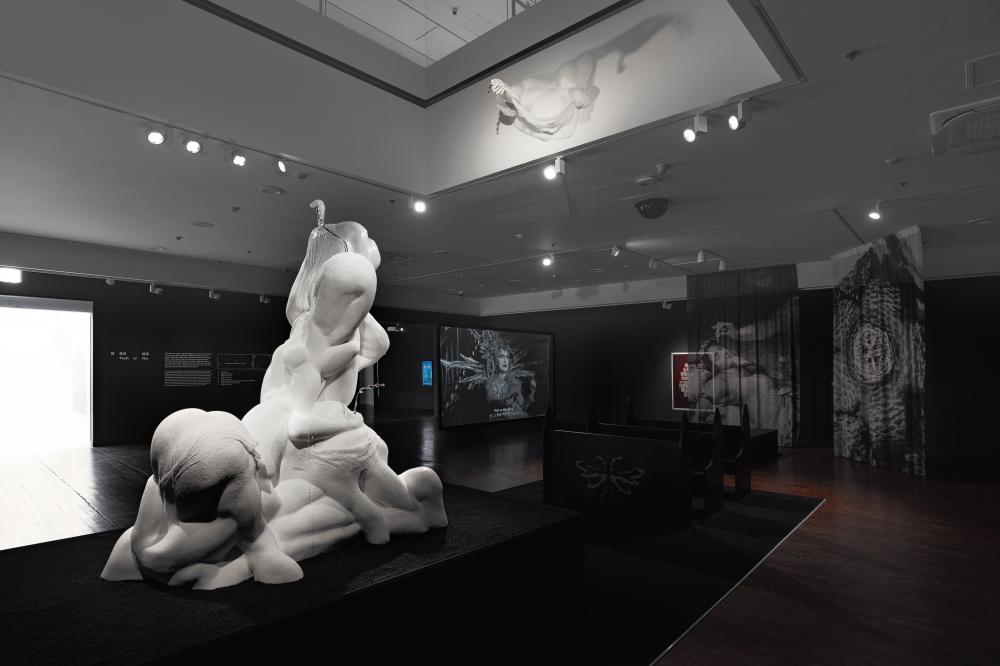
전시전경: 서울시립미술관
Free Admission
Technology is no longer a tool that lies outside life, but an environment that conditions our senses and relationships. We wake to smartphone alarms, move along routes guided by satellites, and spend our days encountering news selected by algorithms. Within that flow, the ways we remember and relate to one another are also changing. The acts of staying by someone’s side, of caring and leaning on each other, are being reshaped within this new condition. What we linger on, then, is the question of where the force that allows one to remain beside another, even amid a changing world, truly begins.
Celebrating the 20th anniversary of the Nanji Residency at the Seoul Museum of Art (Nanji Residency SeMA), AMOR EX MACHINA repositions the word “love” within this question. The exhibition embarks on a journey toward the origin of love―that is, to rediscover the human essence that endures even before the immensity of technological civilization, suggesting that the destination to which we must ultimately return is love itself. At the same time, Amor Ex Machina (“love from the machine”) plays on the classical concept Deus Ex Machina (“god from the machine”). In place of divine intervention, it proposes that in our present world built through technology and mechanical systems, what may still redeem us is love―the fundamental ground of being.
Though we can never fully understand one another, we nevertheless continue to reach out, to care for each other, to lean on one another, and to remain together, even at the risk of being wounded. Compassion, care, interdependence, and connection have long been the ways through which imperfect beings learn to stay beside one another. In an age when technology rewrites the forms of relationships, love reemerges not as a distant abstraction but as a concrete condition that sustains life itself.
The exhibition revisits this condition through archetypal narratives. The wonder and cost of the one who stole fire, the loss and transformation of the one who entrusted memory to a river, and the struggle of the one who returned in an unfamiliar form unfold across scenes of the present. Bodies transform through their entanglement with technology, memories migrate into data, and those who stand outside the system endure the world through their own senses. Stories passed down over long periods do not remain in the past. They become frameworks through which we see the present, while also allowing us to anticipate what has yet to come.
Here, the ancient stories become the language of the now. The artists participating in this exhibition have all passed through the Nanji Residency SeMA over the past twenty years. Their works bear layered traces of the technological environments and shifting sensibilities of their respective times. The time spent rendering, in their own languages, the ways in which technology reshapes the bodies, perceptions, and connections has also been a process of reestablishing the senses and learning how to coexist with others within a transforming world.
What AMOR EX MACHINA ultimately looks toward is the sensibility that continues to make us human even after passing through increasingly refined apparatuses and ever more intricate systems. When ancient stories, contemporary landscapes, and works shaped through the time of Nanji are brought together, love approaches us as a force at work―here and now. Rather than offering love as a singular form, the exhibition invites us to retrace it: like an old journey whose story repeats itself yet arrives at different destinations each time, with each of our own ways.
Press Release: Seoul Museum of Art
Installation View: Seoul Museum of Art