전시 소개 ABOUT THE EXHIBITION
세상의 소란이 멈춘 고요의 중심, 그 ‘정지점(Still Point)’에서 비로소 본질적인 춤이 드러난다. 이번 전시는 침묵의 표면 아래에서 나직이 길어 올린 세 작가의 시선을 펼쳐 보인다. 비어 있는 공간에 머무는 빛의 온기를 통해 존재의 부재를 환기하는 정보영, 욕망되고 버려지는 이미지의 순환 속에서 유령처럼 휘발하는 실재를 기록하는 김휘동, 그리고 무심히 지나치며 사라지는 찰나의 풍경을 담담하고 단단하게 화면 위에 정박시키는 김병진의 작업이 한자리에 모였다.
이들의 작업은 과도한 긴장을 배제한 낮은 리듬을 형성하며, 정물처럼 멈춰 선 풍경의 이면에서 미묘하게 요동하는 생의 파동을 건드린다. 시인 T. S. Eliot은 이러한 상태를 “멈춤도, 움직임도 아닌(neither arrest nor movement)” 자리로 보았다. 엘리엇이 가리킨 이 지점은 단순한 물리적 멈춤이 아니다. 모든 에너지가 응축되어 비로소 존재의 ‘춤’이 시작되는 역설적인 정적의 자리다. 빛이 붙들리고 시간이 고인 듯한 그 중심에서, 관객은 멈춤의 이면을 흐르는 미세한 율동과 마주한다. 그것은 침묵 속에 감춰진 역동이며, 저마다의 서사가 깊숙이 응축된 리듬이다.
"At the still point of the turning world.
Neither flesh nor fleshless;
Neither from nor towards; at the still point, there the dance is,
But neither arrest nor movement. And do not call it fixity,
Where past and future are gathered."
– T. S. Eliot, “Burnt Norton,” from Four Quartets (1943) –
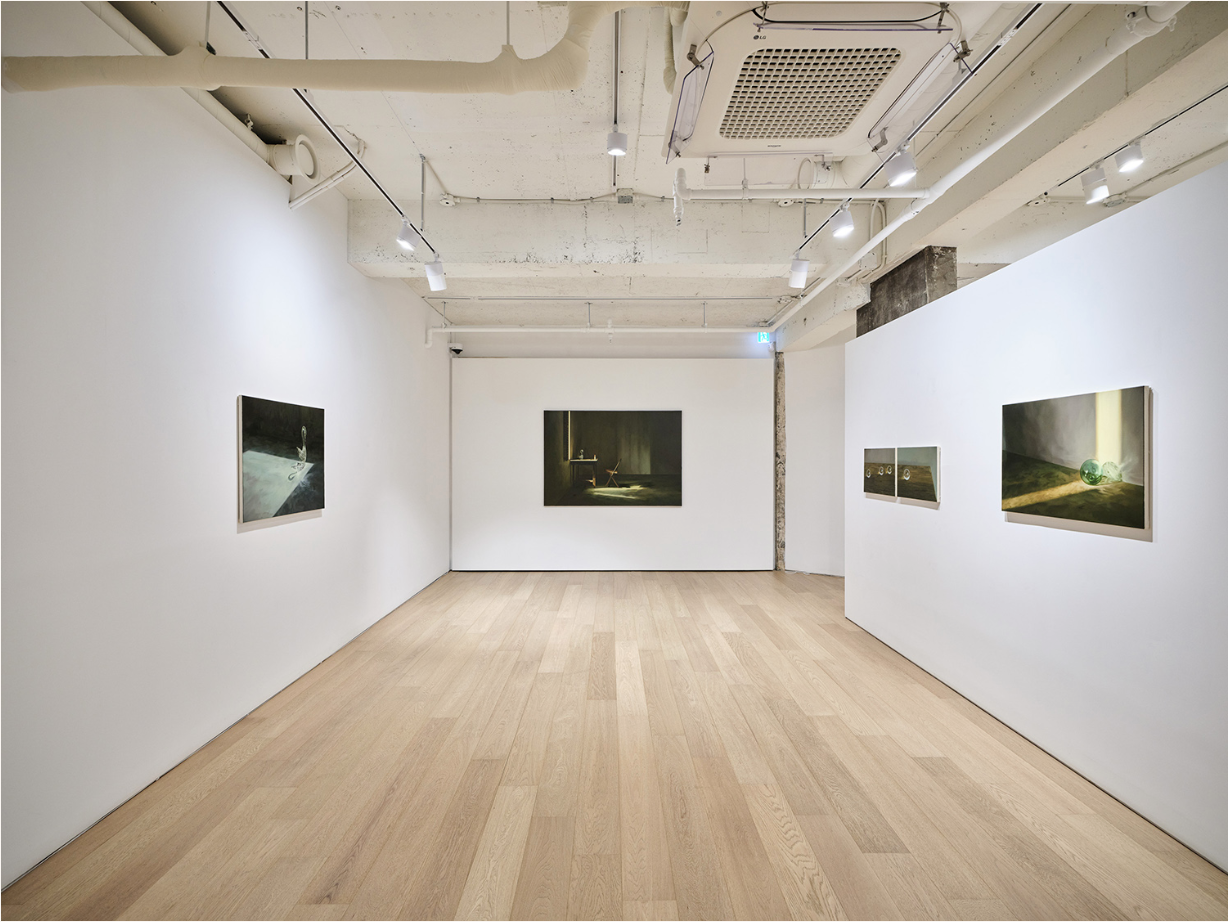
전시는 존재와 부재가 교차하는 경계에서, 사라짐과 남겨짐 사이의 감각을 붙들려는 세 작가의 작업을 펼쳐 보인다. 사진적 시선과 사실적 재현에 기반하지만, 이들의 회화는 현실을 그대로 복제하는 데 머물지 않는다. 화면은 생략된 맥락 위에서 형성되며, 보이는 것과 보이지 않는 것, 남겨진 것과 사라진 것이 겹쳐 스며들며 미묘한 긴장을 드러낸다. 빛의 오묘함을 다면적으로 펼쳐 공감각의 층위를 드러내는 정보영, 낯설게 주목되는 일상의 장면으로 잃어버린 관계의 감각을 끌어당기는 김병진, 부유하는 이미지와 견고한 지지체의 긴장 속에서 회화적 전환을 탐색하는 김휘동의 작업은 서로 다른 리듬으로 흐른다.
오묘함을 다면적으로 펼쳐 공감각의 층위를 드러내는 정보영, 낯설게 주목되는 일상의 장면으로 잃어버린 관계의 감각을 끌어당기는 김병진, 부유하는 이미지와 견고한 지지체의 긴장 속에서 회화적 전환을 탐색하는 김휘동의 작업은 서로 다른 리듬으로 흐른다.
자료 출처: 라니서울
전시전경: 라니서울
At the heart of stillness, at that ‘still point’ where the world’s commotion falls away, the essential dance is revealed. This exhibition brings together three artistic perspectives drawn from beneath the surface of silence. The presence of absence is evoked through the warmth of light lingering in emptied space, as articulated by Boyoung Jung; a reality that evaporates ghostlike within the cyclical structure of desired and discarded images, traced in the practice of Wheedong Kim; and fleeting moments that pass almost unnoticed, anchored with a restrained and solid density on the canvas, by Byoungjin Kim.
Their works unfold in a subdued rhythm, revealing subtle tremors beneath seemingly stilled scenes. T. S. Eliot described such a condition as “neither arrest nor movement”—a still point where all energy condenses and the essential dance begins, a paradox of stillness. At this center, where light is held and time seems to settle, a subtle movement persists within stillness. It carries layered, unspoken narratives—a dynamism concealed within silence, a current in which each narrative is deeply condensed.
Situated at the threshold where presence and absence intersect, the exhibition engages the tension between disappearance and what remains. Grounded in a photographic sensibility yet moving beyond replication, the works extend beyond mere reproduction. The image emerges from omitted contexts, where the visible and the unseen, the retained and the lost, overlap and permeate one another, revealing a subtle yet persistent tension.
The sensorial complexity of light emerges across layered perception, in the work of Boyoung Jung; a sense of lost relationality arises through estranged everyday scenes, in Byoungjin Kim’s paintings; and painterly transformation takes shape through the interplay between drifting imagery and a rigid support, in Wheedong Kim’s work. Each carries a distinct cadence.
Press Release: Ranee Seoul
Installation View: Ranee Seoul