전시 소개 ABOUT THE EXHIBITION
《보헤미아는 바다 사이에 있다》는 잉게보르크 바흐만의 문장 “보헤미아는 바닷가에 있다”에서 출발한다. 원문이 내륙의 장소를 바다 위에 놓음으로써 현실과 이상향 사이의 긴장을 만들어낸다면, 전시에서 작가는 장소를 이상향의 문제로 환기하는 동시에, 관측의 방향과 스케일에 따라 달라지는 인식의 상태까지 확장한다. 실제 보헤미아 지역에는 바다가 없지만, 지도를 넓히면 발트해와 지중해 사이에 놓인다. 이때 드러나는 어긋남은 단순한 오류가 아니라, 이상향과 현실, 그리고 관측의 조건이 교차하는 지점에서 발생하는 긴장으로 바라볼 수 있다.
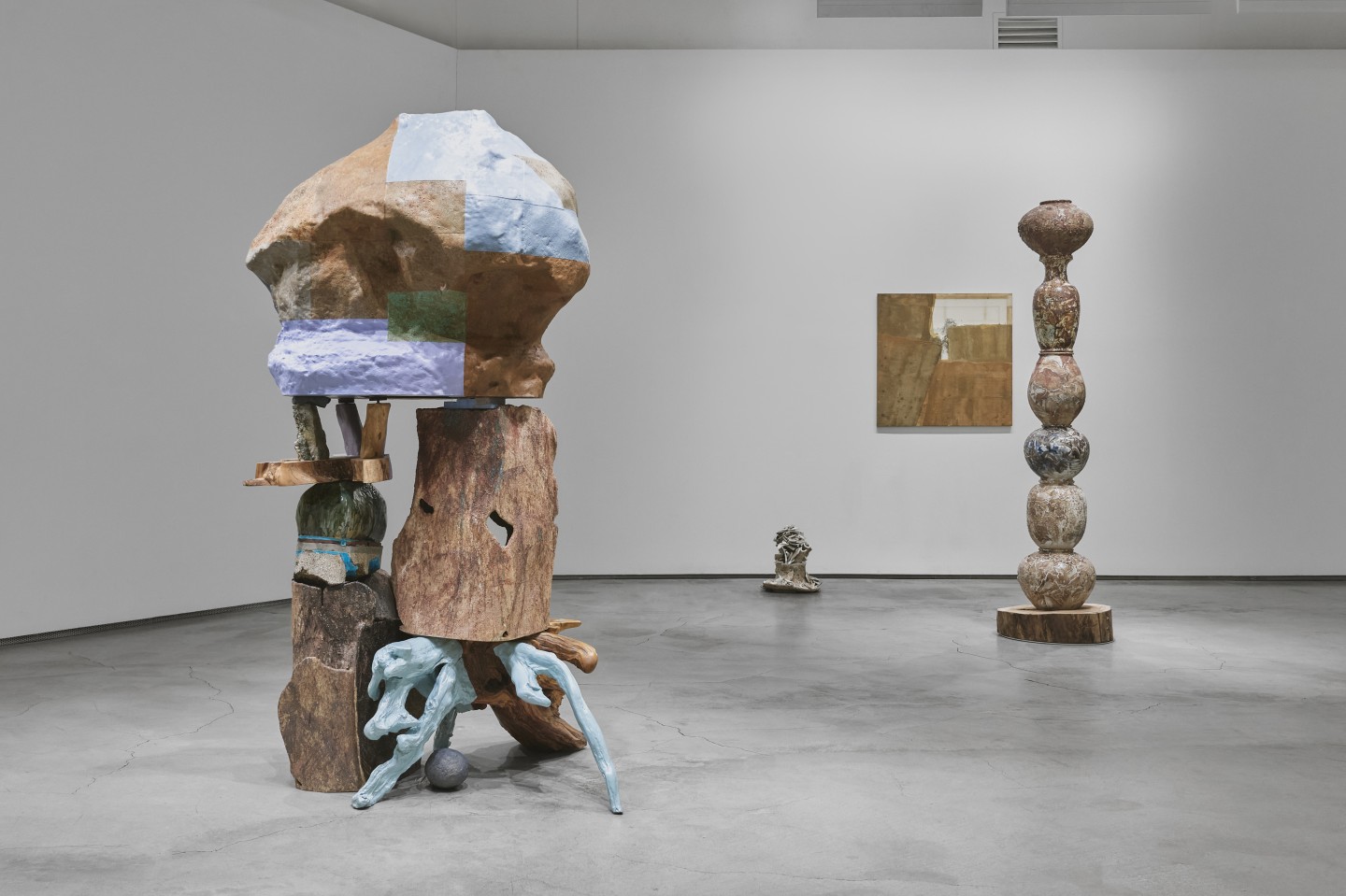
전시는 풍경과 자연을 사유하고 재현하는 태도들을 겹쳐본다. 일반적으로 동양에서 산과 돌은 마음을 담는 자연물로 이해되어 왔으며, 축소된 자연은 하나의 세계로 사유될 수 있었다. 반면 서구적 전통에서 자연은 관측되고 측량되며 분석되는 대상으로 다뤄져 왔다. “보헤미아는 바다 사이에 있다”라는 문장은 이러한 태도 사이를 오가며, 자연을 고정된 이미지가 아닌 끊임없이 변화하는 상태로 사유하게 한다. 작가는 <괴석>을 통해, 자연이 관념이나 이미지로 재현되기 전의 물질적 순간을 드러낸다. 일상의 흙으로 세라믹을 실험했던 기존 방법론의 연장선에 있는 이 작업은, 자연과 인공이 충돌하는 표면과 형태, 모호한 스케일로 인해 관람자의 판단을 유보한다. 작업과 관람자의 거리감에서 발생하는 감각을 통해, 자연과 조각, 그리고 물질과 형태의 경계를 탐색하게 한다.
는 중고 거래 플랫폼을 통해 수집한 도자기와 산수화를 출발점으로 삼는다. (작가는 이를 ‘당근-산수’로 부르기도 한다) 바위나 암산이 그려진 사물들은 전통적인 산수화의 방식에 따라 붓질을 전면적으로 드러내며, 관념적 이상향의 표지로 기능해 왔다. 작가는 이러한 사물들을 또 하나의 사물-풍경으로 인식하고, 그 위를 다시 흙과 광물 가루로 덮는다. 이 과정에서 ‘산’은 더 이상 그려지는 대상이 아니라, 그 자체로 붓질이 되는 주체가 된다. 흙으로 남겨진 산의 흔적은 이미지를 넘어선 행위의 기록이며, 기존의 관념적 이미지 위에 새롭게 더해진 물질은 중첩되거나 화학적으로 반응하며 공존한다.
한편, 작가는 자연을 인식하는 또 다른 축으로서, 풍경을 기록하고 재구성하는 기술적 시선에 주목한다. 원근법에서 출발한 시각 중심의 사고는 다수의 사진 이미지를 통해 공간 구조를 계산하는 사진측량(Photogrammetry) 기술로 확장되어 왔다. <삼신산>은 창덕궁 낙선재 화계 앞에 놓인 분형괴석을 대상으로, 웹에 축적된 불특정 다수의 사진 이미지를 사진측량 프로그램을 사용해 3D 모델로 제작·출력한 것이다. 이 데이터는 사람들의 시선과 선호에 따라 지속적으로 축적되고 갱신되어 출력될 것이다.
이러한 작업들은 <석가산>이라는 구조 속에서 서로 관계를 맺는다. 3D 스캔·프린트된 수석과 괴석, 인공적으로 제작된 바위, 일상의 흙으로 만든 세라믹, 그리고 타인이 마음으로 즐겨왔던 자연물들이 층층이 쌓여 하나의 인공 산을 이룬다. 이는 자연, 관념, 기술, 취향이 서로 다른 스케일과 태도로 중첩된 결과물이자, 동양적 내면화의 태도와 서구적 측량의 시선이 충돌하고 공존하는 장이 된다. 《보헤미아는 바다 사이에 있다》는 자연을 하나의 대상이나 이미지로 고정하지 않는다. 대신 물질과 이미지, 관념, 눈과 카메라, 손과 3D 프린터가 뒤엉키듯 교차하며, 오늘날 우리가 세계를 어떻게 인식하고 있는가에 대한 질문을 남긴다.
자료 출처: G 갤러리
전시전경: G 갤러리
Bohemia Lies Between Seas begins with a sentence by Ingeborg Bachmann: “Bohemia lies by the sea.” By placing an inland region upon the sea, the original line creates a tension between reality and utopia. In this exhibition, Moon Isaac invokes place as a question of the ideal, while extending it toward states of perception that shift according to the direction and scale of observation. Although Bohemia has no coastline, when one widens the map, it can be understood as lying between the Baltic Sea and the Mediterranean. The discrepancy that emerges here is not a simple error, but a tension produced at the intersection of utopia and reality, and of the conditions of observation.
The exhibition layers different modes of contemplating and representing landscape and nature. In East Asian traditions, mountains and stones have often been understood as natural forms that embody the mind, with miniature landscapes conceived as complete worlds in themselves. In contrast, within Western traditions, nature has largely been treated as an object to be observed, measured, and analyzed. The phrase “Bohemia lies between seas” moves between these attitudes, prompting us to consider nature not as a fixed image, but as a continuously shifting state.
Through Goeseok, he reveals a material moment prior to nature’s translation into concept or image. Extending earlier experiments with everyday soil and ceramics, this work suspends the viewer’s judgment through surfaces and forms where the natural and the artificial collide, as well as through ambiguous scale. The sensory experience produced by the distance between the work and the viewer becomes a space for exploring the boundaries between nature and sculpture, and between material and form.
Mountain Stroke begins with ceramics and landscape paintings collected from secondhand trading platforms (which he refers to as “Carrot-Landscapes”). Objects depicting rocks or craggy mountains traditionally foreground expressive brushwork and have functioned as markers of an idealized utopia. He recognizes these items as object-landscapes in their own right and covers them anew with soil and mineral powder. In this process, the “mountain” is no longer something depicted; it becomes the subject that is itself the brushstroke. The traces of mountains left in soil are records of action beyond image. Newly added material coexists with preexisting conceptual imagery, layering over it or chemically reacting with it.
At the same time, he turns to another axis of perceiving nature: the technological gaze that records and reconstructs landscape. The vision-centered logic that originated in linear perspective has expanded into photogrammetry, a technique that calculates spatial structure through multiple photographic images. Samshinsan (Three Immortal Mountains) is created using photogrammetry software applied to numerous photographs of a Bunhyeong Goeseok (Oddly Shaped Ornamental Stone) placed before the terraced garden of Nakseonjae at Changdeokgung Palace. These anonymously accumulated web images are processed into a 3D model and printed. As images shaped by individual viewpoints and preferences continue to circulate, the dataset will be continually accumulated, updated, and reproduced.
These works converge within the structure of Seokgasan. 3D-scanned and printed scholar’s stones, artificially fabricated boulders, ceramics made from everyday soil, and natural objects long appreciated by others are layered to form a single constructed mountain. It becomes both the result of overlapping scales and attitudes—nature, concept, technology, and taste—and a site where East Asian modes of internalization and Western traditions of measurement collide and coexist.
Bohemia Lies Between Seas does not fix nature as a singular object or image. Instead, material and image, concept, eye and camera, hand and 3D printer intersect and entangle, leaving open the question of how we perceive the world today.
Press Release: G Gallery
Installation view: G Gallery