전시 소개 ABOUT THE EXHIBITION
두아르트 스퀘이라는 조나단 울리엘 살다냐의 서울 첫 개인전 《찬스 룸》을 선보인다.
본래의 기능을 멈춘 사물에는 특유의 멜랑콜리가 깃든다. 윤곽은 남아 있지만 옛 목적은 조용히 사라진다. 살다냐는 지난 20여 년 동안 사운드, 퍼포먼스, 비디오와 자신이 설립하고 이끌어 온 콜렉티브를 통해 이와 유사한 상태를 탐구해 왔다. 그는 목소리와 리듬을 그것을 만들어 낸 순간이 지나간 뒤에도 잔여를 품는 것으로 다뤘다. 《찬스 룸》은 이 문제를 사물의 영역으로 옮긴다. 여기서 결여된 것은 직접 명명되지 않으며, 작품들은 바로 그 부재로 이루어진다.
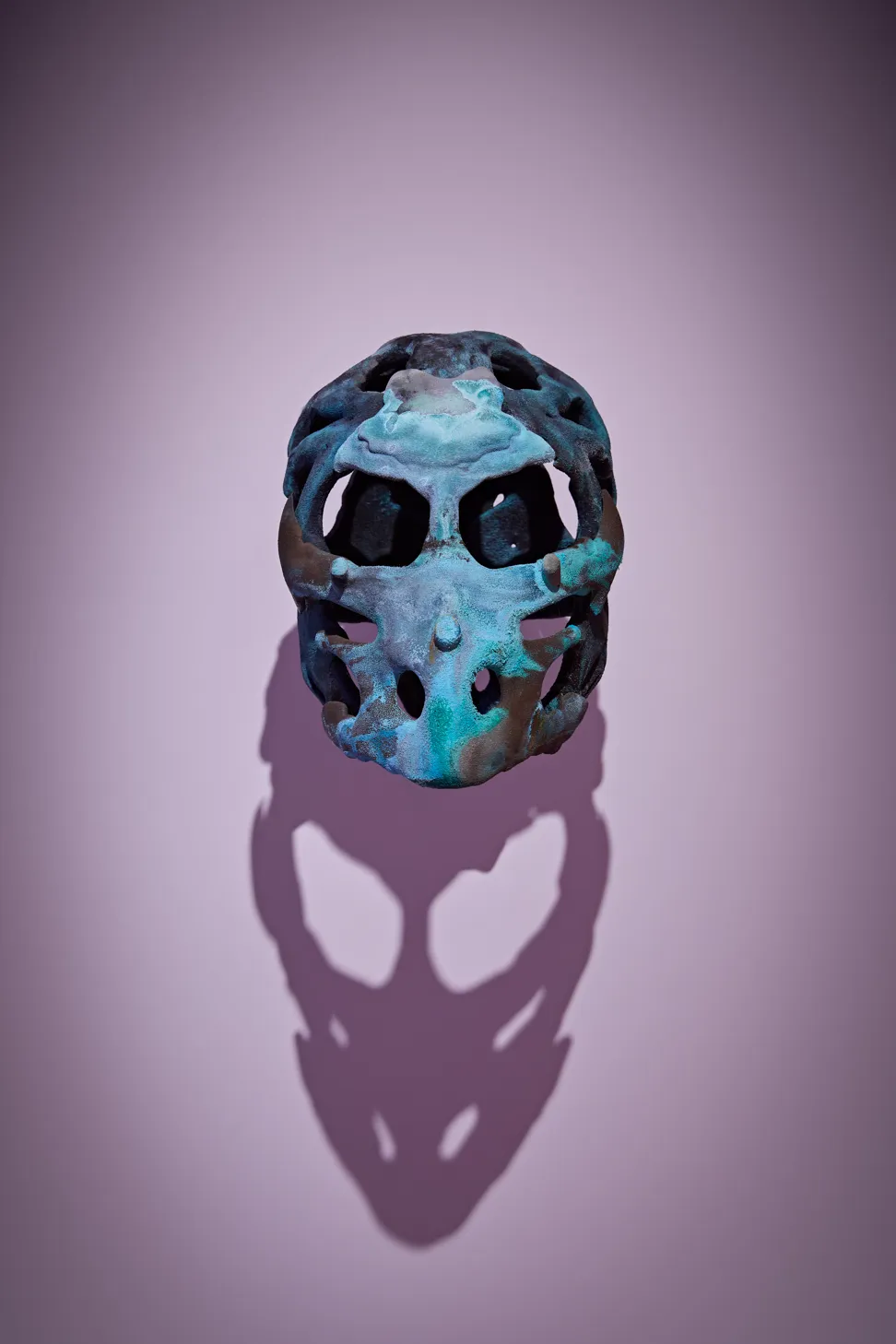
산화하도록 내버려 둔 헬멧은 서서히 두개골을 닮아간다. 부식이 진행되며 보호 장치로 인식되게 했던 속성은 별다른 사건 없이 물러난다. 여러 인물 형상은 검은 레진 아래에서 사라지고, 잃어버리는 것은 몸이 아니라 개별성이다. 서로 분리되어 있던 형상들이 하나의 연속적이고 희미하게 반사되는 표면으로 융합된다. 얕은 부조에서는 몸이나 장치가 차지했던 공간, 곧 부피 자체가 비워지고 차원성의 기억만을 제시하는 이미지로 대체된다. 〈Mouth Head〉는 이 비움을 가장 멀리 밀어붙인다. 말과 숨, 소리에 쓰였던 얼굴은 하나의 구멍으로 축소되고, 이제는 그 안을 들여다보는 데에만 쓰인다.
이 모든 것이 실패에 관한 논증으로 귀결되지는 않는다. 실패라면 단순히 기능을 잃었다고 말할 수 있어야 한다. 이 작품들을 떠도는 것은 오히려 목적 없는 지속에 가깝다. 사물이 자신의 쓰임보다 오래 살아남아 방향을 잃었지만 온전한 채로, 한때 몸이나 방패가 차지했던 공간을 계속 점유하는 감각이다. 이 상태는 성물함, 외골격, 그리고 보호하던 것이 사라진 뒤 산업 노동이 남기는 외피에 이르기까지 오랜 전사를 지닌다. 살다냐의 조각은 그 역사를 인용이라기보다 낮고 주변적인 슬픔으로 물려받는다. 전반적인 어조는 비평보다 애도에 더 가깝지만, 여기서 둘을 온전히 나누기는 어렵다.
Duarte Sequeira is pleased to present Chance Room, the first exhibition in Seoul by Jonathan Uliel Saldanha.
There is a particular melancholy that belongs to objects which have stopped doing what they were built for: present in outline, their old purpose quietly missing. Saldanha has spent most of the last two decades working with an equivalent condition in sound, performance, video and the collectives he has founded and directed, treating voice and rhythm as things that carry a residue long after the moment that produced them has passed. Chance Room moves that same problem into the register of the object. What is missing here is never named directly. Its absence is what the pieces are made of.
A helmet, left to oxidise, drifts into resembling a skull, corrosion working on it slowly, the property that once made it recognisable as protection withdrawing without incident. Groups of figures disappear under black resin, and what is lost is not the body but its separateness, several individuated forms fusing into one continuous, faintly reflective surface. In the shallow reliefs, volume itself, the space a body or a device once occupied, is evacuated, replaced by an image that offers only the memory of dimensionality. Mouth Head takes this evacuation furthest: a face reduced to a single opening, once used for speech, breath, sound, now only for looking inward.
None of this settles into an argument about failure. Failure would require a function that was simply lost. What haunts these works instead is closer to persistence without purpose, the sense that an object can outlive its own use and carry on regardless, disoriented but intact, still occupying the space a body or a shield once occupied. This condition has a long prior history, in reliquaries, in exoskeletons, in the casings industrial labour leaves behind once whatever they protected has gone, and Saldanha's sculptures inherit that history as a kind of low, ambient grief rather than a citation. The tone throughout is closer to mourning than to critique, though the two are difficult to fully separate here.