전시 소개 ABOUT THE EXHIBITION
《알렉사에게》는 인간의 능동적인 정보 탐색 과정이 인공지능에 의해 자동화되고 있는 오늘날, 정보로 재구성된 현실이 우리에게 다가오는 방식을 되짚어 보는 전시다. 신문의 편집 구조가 하루 동안 일어난 여러 사건의 중요도를 규정하고, 검색 엔진의 사용자 친화적 알고리즘이 정보 노출의 우선순위를 재배치하듯, 정보를 탐색하고 수집하는 과정에는 언제나 정보 인터페이스에 의해 구조화된 제약이 전제되어 있다. 이러한 정보 인터페이스의 연결망은 우리가 정보를 통해서 현실에 다가서고자 할 때 인식의 경로를 매개하는 핵심 조건으로 작동해 왔다. 신문과 라디오를 거쳐 가정용 TV와 개인용 컴퓨터로, PC 통신과 무선 인터넷을 거쳐 스마트폰과 SNS로, 기술이 발전할수록 일상에 스며든 정보 인터페이스가 야기하는 제약은 점점 더 추상화된다.
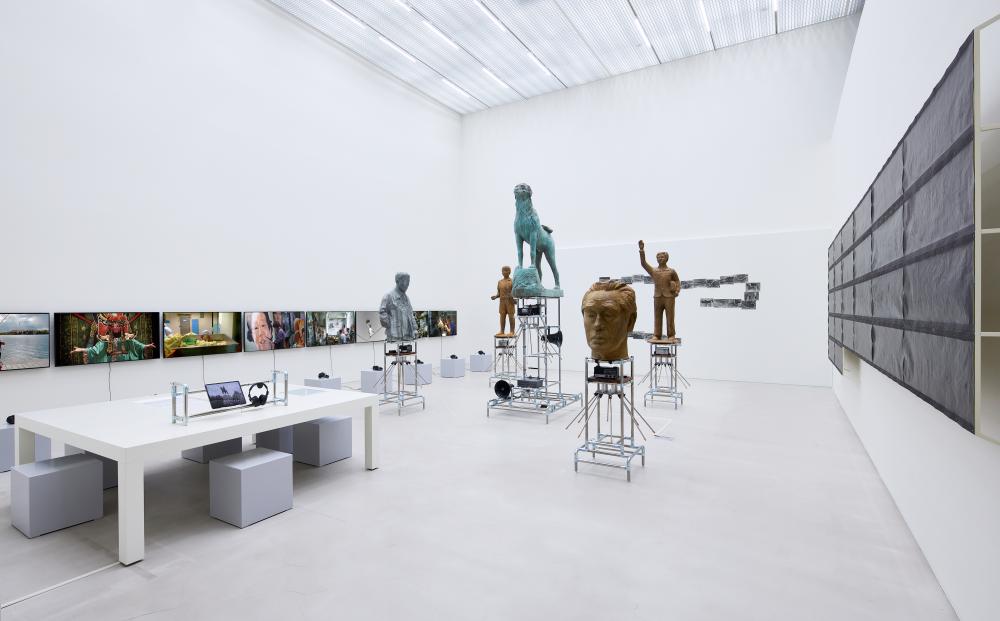
이번 전시는 이러한 기술 매체 환경의 변화에 대처해 온 동시대 미술가들의 실천을 경유하여, 현실과 정보 사이의 미로 속에서 능동적으로 길을 찾는 방법을 질문하고자 기획되었다. 1980년대부터 2020년대까지 지난 50여 년의 정보 인터페이스 변화를 아우르는 동시대 미술 작가 8인의 작업은, 정보 인터페이스가 야기하는 제약을 창작의 조건으로 전유하며 정보화된 현실의 구조를 비판적으로 바라본다. 이들은 서로 관련 없어 보이는 정보들을 하이퍼링크적으로 연결하면서 비선형적인 지도를 만들고, 역사적 기념비를 정보 송수신기로 재해석하거나, 자료 수집 과정에서 맞닥뜨리게 되는 의구심과 곤혹을 역으로 밀어붙인다. 이러한 실천 속에 깃든 정보들은 시대의 변화를 선반영하는 지표가 되기도 하고, 때로는 작가의 의도를 넘어서는 역사적 맥락을 새롭게 형성하기도 한다.
전시는 전시실1과 전시실2에 각각 배치된 ‘보낸 편지함’과 ‘받은 편지함’으로 구성된다. 이메일 인터페이스에서 ‘보낸 편지함’이 과거에 발신한 정보를 다시 살펴보는 공간이듯, 전시실1에서는 지나쳐 온 정보 사이를 헤매면서 현실이 인식되는 조건 자체를 되돌아보는 작업을 소개한다. 반면 ‘받은 편지함’은 계속해서 새로운 정보가 흘러 들어와 과거의 정보 위에 쌓이는 공간이다. 따라서 전시실2에서는 한 시대의 편린을 수집하고 인덱스의 형식으로 재구성한 작업들을 소개하는 동시에, 수집된 정보를 역사적 자료로서 추출하여 대안적 아카이브로 재해석한다. 이를 통해 정보로 재구조화되어 있는 당대의 현실을 관객 스스로 파헤쳐 볼 것을 제안하고자 하였다.
전시 제목의 ‘알렉사’는 인류의 모든 지식과 정보를 한곳에 수집하고자 했던 고대 알렉산드리아 도서관을 연상시키는 이름이다. 하지만 그 이름은, 인터넷 서점에서 출발한 세계 최대 규모의 클라우드 기업이 서비스 중인 대화형 AI 플랫폼의 명칭으로도 쓰이고 있다. 최근 한 AI 기업이 중고 서적 수백만 권을 도서관에서 구입한 후 인공지능 학습에 활용했다는 뉴스는, 인간이 직접 시간을 들여 정보를 찾던 과정이 간단한 질문 입력 행위로 압축되고 있는 현실의 단면을 의미심장하게 비춘다. 이처럼 정보를 통해서 현실을 인식하는 과정이 AI와의 문답으로 간소화되는 시대에, 《알렉사에게》는 능동적인 정보 탐색자가 되어볼 것을 제안한다. 이는 미술의 기록을 보존하고 연구 기반을 만들어 가는 미술아카이브의 존재 의의를 돌아보기 위한 실천이기도 하다.
Free Admission
Dear Alexa is an exhibition that revisits the way a reality reconfigured through information reaches us today, at a moment when the active human process of seeking information is being automated by artificial intelligence. Just as the editorial structure of a newspaper can determine the relative importance of events that occur over the course of a day, and user-friendly search engine algorithms can reorder the priority of information exposure, the process of searching for and collecting information always presupposes constraints structured by information interfaces. As such, the network of these information interfaces has long functioned as a key condition mediating the pathways of perception whenever we attempt to access reality through information. From newspapers and radio to domestic television and personal computers, from PC communications and wireless internet to smartphones and social media, the constraints generated by such information interfaces become increasingly abstract as technology continues to advance and permeate our daily lives.
Through the practices of contemporary artists who have responded to changes in the technological media environment, this exhibition asks how we ourselves might actively find our way through the maze that lies between information and reality. Spanning more than fifty years of shifting information interfaces, from the 1980s to the 2020s, the works of these eight contemporary artists critically examine the structure of our information-driven reality by appropriating the constraints produced by information interfaces as conditions of artistic creation. They construct non-linear maps by hyperlinking seemingly unrelated pieces of information, reinterpret historical monuments as information interfaces, and push further the doubts and perplexities encountered in the process of gathering materials. At times, the information embedded within these practices can serve as an index that prefigures changes in the times; at others, they actually form new historical contexts that exceed the artists’ intentions.
The exhibition is divided into Gallery 1 and Gallery 2, titled “Sent” and “Inbox,” respectively. Just as the “Sent” folder of an email interface is a space where information previously sent can be revisited, Gallery 1 presents works that wind their way through information we have already experienced, prompting a reconsideration of the very conditions through which reality is perceived. By contrast, the “Inbox” is a space into which new information continually flows, accreting over earlier information. Accordingly, Gallery 2 introduces works that collect fragments of a given era and reconfigure them in the form of an index, while also extracting the collected information as historical material and reinterpreting it as an alternative archive. In this way, Dear Alexa invites viewers to investigate the contemporary reality restructured through information for themselves.
The “Alexa” in the exhibition title evokes the ancient Library of Alexandria, which sought to gather all human knowledge and information in one place. At the same time, this name is also used for a conversational AI platform operated by one of the world’s largest cloud companies, which began as an online bookstore. Recent news that an AI company purchased millions of secondhand books from libraries and used them for AI training offers a telling glimpse into a reality in which the human process of searching for information is being compressed into the simple act of entering a question. In an age when the process of understanding reality through information is being simplified into exchanges with AI, Dear Alexa proposes that we become active seekers of information. It is also an act of reflecting on the significance of the art archive itself, with its mission of preserving records and building a foundation for research.
Press Release: Seoul Museum of Art
Installation View: Seoul Museum of Art