전시 소개 ABOUT THE EXHIBITION
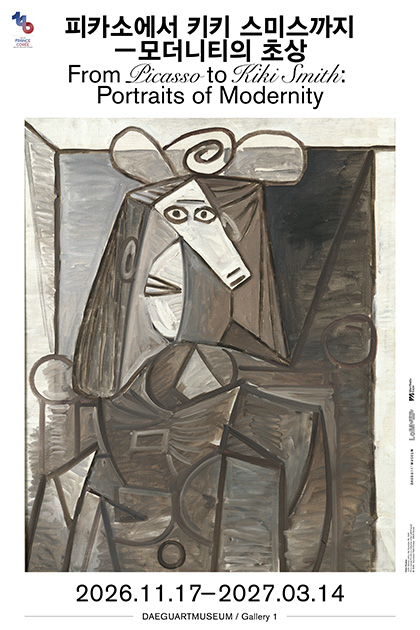
《피카소에서 키키 스미스까지-모더니티의 초상》은 대구미술관과 프랑스 릴 메트로폴 현대미술관이 서로의 소장품을 매개로 기획한 국제 교류전으로, 근대에서 동시대에 이르기까지 예술가들이 바라본 인간과 세계의 모습을 ‘초상’이라는 주제를 통해 조망한다. LaM미술관은 프랑스 북부의 유력한 섬유사업가 집안 출신 제네비에브와 장 마쥐렐 부부가 기증한 근대미술 컬렉션을 소장하기 위해 1983년 개관하였으며, 현재 프랑스 미술계에서 중요한 위치를 차지하고 있는 공립미술관이다. 이어 수집가 로제 뒤틸뢰유의 후손들의 기증 덕분에 40여 년 동안 8,000여 점이 넘는 뛰어난 아방가르드 작품들을 프랑스 관객에게 선보여 왔으며, 이번 전시를 통해 한국에도 소개하게 되었다. 특히 한불수교 140주년을 맞은 올해, 프랑스와 한국, 두 문화권의 미술관이 소장품을 통해 서로의 시각과 예술적 경험을 나누고, 근대성의 다양한 표정을 함께 살펴본다는 점에서 의미가 깊다.
20세기 초 미술은 전통적인 재현의 방식에서 벗어나 인간과 세계를 바라보는 새로운 시각을 모색하기 시작했다. 초상은 더 이상 한 인물의 외모와 신분을 기록하는 데 머물지 않고, 시대의 감각과 개인의 내면, 사회와 문화의 변화를 드러내는 중요한 예술적 장르로 확장되었다.
아메데오 모딜리아니, 파블로 피카소, 페르낭 레제, 조르주 브라크, 호안 미로 등 근대미술을 대표하는 작가들의 작품에서는 인물의 형상에 대한 새로운 해석과 함께, 급변하는 시대 속에서 인간을 바라보는 다양한 태도를 발견할 수 있다. 이들에게 초상은 현실의 모습을 재현하는 동시에, 분절되고 변형되며 때로는 단순화된 형상을 통해 인간 존재와 시대정신을 탐구하는 장이었다. 그러나 ‘초상’의 의미는 근대에 머물지 않는다. 동시대 작가들은 신체와 얼굴, 개인의 정체성뿐 아니라 기억과 사회, 이미지와 대중문화의 관계를 새롭게 질문한다. 키키 스미스, 밈모 로텔라, 안나 오퍼만 등의 작품은 초상의 경계를 확장하며, 인간을 둘러싼 이미지가 어떻게 생성되고 소비되며 기억되는지를 보여준다. 또한 신체의 파편과 흔적, 도시의 이미지, 대중매체의 기호와 일상의 사물 등 다양한 매체와 표현방식은 오늘날 초상이 더 이상 특정한 한 사람의 모습을 의미하지 않음을 보여준다. 그것은 개인의 내면이자 사회의 풍경이며, 우리가 살아가는 시대를 비추는 하나의 거울이 된다.
이번 전시는 회화와 조각, 사진, 드로잉을 아우르며, 약 100여 점의 작품을 통해 이러한 변화의 흐름을 살펴본다. 특히 전시 작품 가운데 대구미술관 소장품 6점이 함께 소개되면서, 미술관이 축적해 온 컬렉션의 의미가 프랑스의 대표적인 현대미술관인 LaM의 소장품과 만나 새로운 맥락을 형성한다. 전시 구성에서는 작품의 제작 연도에 따른 연대기적 흐름이 아닌, 총 7개의 테마 속에서 20세기 초 모더니즘의 탄생부터 아르 브뤼(Art Brut), 그리고 오늘날의 동시대 미술에 이르기까지 세 개의 거대한 예술적 축을 교차시킨다. 전통적인 종교적·역사적 서사에서 벗어나 현대인의 복잡한 내면을 포착한 20세기 모더니즘 걸작들은 모더니티의 시작을 보여준다. 이와 궤를 같이하는 LaM의 세계적인 아르 브뤼 소장품은 이성 중심의 사회 뒤편에 존재하는 인간 근원의 날것 그대로의 순수한 초상을 드러내며 미학적 경계를 확장한다. 이 흐름은 오늘날 이미지로 포화된 사회 속에서 끊임없이 자아와 타인을 탐색하는 동시대 작가들의 시선으로 이어진다.
이번 전시는 서로 다른 역사와 문화적 배경을 지닌 두 기관의 소장품이 하나의 주제 아래 만나면서 작품 사이의 새로운 관계와 대화를 만들어내는데 중점을 둔다. 이를 계기로 시대를 초월해 끊임없이 움직이고 해체되며 재정의되는 인간의 존엄한 초상들을 마주하는 소중한 기회가 될 것이다. 근대미술에서 동시대미술에 이르는 작품들의 만남을 통해 우리가 익숙하게 보아 온 ‘초상’의 의미를 새롭게 발견하고, 인간과 시대, 이미지와 기억의 관계를 생각해보는 시간이 되기를 바란다.
From Picasso to Kiki Smith: Portraits of Modernity is an international exchange exhibition co-organized by the Daegu Art Museum and the Lille Métropole Musée d'art moderne, d'art contemporain et d'art brut (LaM), drawing on the collections of both institutions. Taking the portrait as its lens, the exhibition examines how artists from the modern era to the present have envisioned humanity and the world. LaM opened in 1983 to house the collection of modern art donated by Geneviève and Jean Masurel, members of a prominent textile family in northern France, and has since become a leading institution in the French museum landscape. Thanks to a subsequent gift from the heirs of the collector Roger Dutilleul, the museum has shared more than 8,000 exceptional avant-garde works with the French public over some four decades. Those works can now be discovered at the Daegu Art Museum. Coinciding with the 140th anniversary of diplomatic relations between Korea and France, the exhibition takes on particular significance: through their collections, two museums rooted in different cultural traditions share their perspectives and artistic experience, and together explore the many faces of modernity.
At the dawn of the twentieth century, art began to break with traditional modes of representation in search of new ways of seeing humanity and the world. No longer confined to recording a sitter's appearance and social standing, the portrait became a vital artistic genre. It could now reveal the sensibility of its age, the inner life of the individual, and the shifting currents of society and culture.
In the work of such defining figures of modern art as Amedeo Modigliani, Pablo Picasso, Fernand Léger, Georges Braque, and Joan Miró, we encounter new interpretations of the human figure alongside a range of responses to humanity in a rapidly changing age. For these artists, the portrait was both a means of representing reality and a field of inquiry into human existence and the spirit of the times. They pursued that inquiry through forms that were fragmented, transformed, and at times simplified. Yet the meaning of the portrait does not end with modernism. Contemporary artists pose new questions about the body, the face, and individual identity, and also about the relationship between memory and society, and between images and popular culture. Kiki Smith, Mimmo Rotella, Anna Oppermann, and others push the boundaries of the genre, revealing how the images that surround us are produced, consumed, and remembered. Their materials and methods range across fragments and traces of the body, urban imagery, the signs of mass media, and everyday objects. That range makes clear that a portrait today need no longer depict one particular person. It is at once an inner world and a social landscape: a mirror held up to the times in which we live.
Spanning painting, sculpture, photography, and drawing, the exhibition traces these developments through some one hundred works. Six works from the Daegu Art Museum's collection are presented alongside those of LaM, one of France's foremost museums of modern and contemporary art, bringing the two collections into dialogue and opening up new contexts. Rather than following a chronological sequence, the exhibition is organized into seven thematic sections. Across them, three major strands intersect: the birth of modernism in the early twentieth century, Art Brut, and the art of our time. The masterpieces of twentieth-century modernism, which broke with traditional religious and historical narratives to capture the complex inner lives of modern individuals, mark the beginning of modernity. In the same spirit, LaM's internationally renowned Art Brut collection expands the boundaries of aesthetics. It reveals raw, unmediated portraits of the human essence that lie beneath a society founded on reason. This current extends into the work of contemporary artists who continually probe the self and the other in today's image-saturated world.
By bringing together, under a single theme, the collections of two institutions with distinct histories and cultural backgrounds, the exhibition seeks above all to foster new relationships and dialogues between works. It offers a rare opportunity to encounter portraits of human dignity that transcend time, portraits perpetually in motion, dismantled, and redefined. We hope that this meeting of modern and contemporary works will invite visitors to rediscover the meaning of the portrait, a genre long familiar to us, and to reflect on the relationships between humanity and its time, and between image and memory.