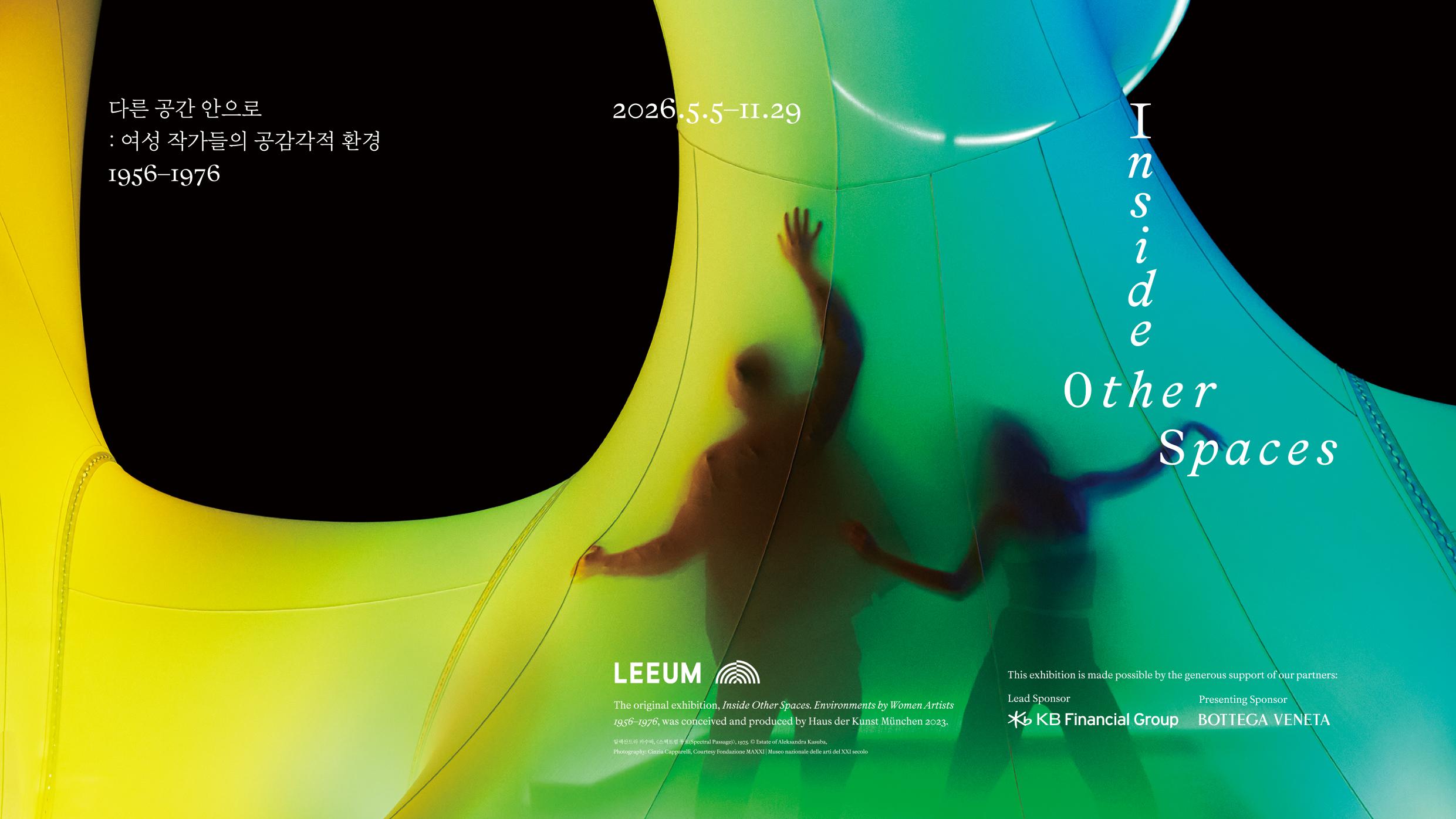
전시 소개 ABOUT THE EXHIBITION
관람료: 성인 18,000원
《다른 공간 안으로: 여성 작가들의 공감각적 환경 1956–1976》은 전후 현대미술사가 오랫동안 지나쳐 온 여성 작가들의 환경 작업을 체계적으로 재조명하는 국제기획전입니다.
'환경(ambiente/environment)'은 관람자가 공간 안으로 걸어 들어가 빛, 소리, 색, 공기, 움직임을 온몸으로 경험하는 몰입형 예술 형식입니다. 관람자는 대상(object)을 바라보는 대신 공간 자체를 경험하며, 그 안으로 들어서는 순간 비로소 작품은 완성됩니다. 1949년 루치오 폰타나(Lucio Fontana)가 처음 선보인 '환경(ambiente)'은 이후 20여 년간 여러 작가들에게 급진적인 실험의 장이었으나, 1976년 베니스 비엔날레를 기점으로 서서히 ‘설치’라는 용어로 흡수되며 그 고유의 역사를 잃었습니다.
'환경'은 좌대에 놓이지 않고, 벽에 걸리지 않으며, 거래의 단위로 환원되지 않습니다. 그래서 제도 미술의 중심에서 비켜서 있던 여성 작가들에게 이러한 조건은 오히려 해방의 공간이 되었습니다. 반면 회화·조각 위주로 쓰인 남성 중심의 미술사에서 이들의 작업은 가장 먼저 누락되었습니다. 게다가 환경은 작업 특성상 전시 후 해체되어 폐기되는 경우가 많았고, 기록도 거의 남지 않아 그 역사는 두 번 지워졌습니다.
이 전시는 그 지워진 역사를 되돌리는 데서 출발합니다. 공동 기획자 안드레아 리소니(Andrea Lissoni)와 마리나 푸글리에세(Marina Pugliese)는 작가, 유족, 재단, 아카이브와의 협력 속에서 세계 각지에 흩어진 사진, 도면, 서신, 비평을 발굴하여 각 환경을 최초 공개 당시의 모습에 가장 가깝게 복원했습니다. 복원된 작업은 운송 대신 각 순회 기관과 현지의 조건에 맞추어 재제작합니다. 각 기관의 시각에 따라 새로운 작가, 새로운 장르, 새로운 시기가 추가되면서 전시는 매번 다르게 변화합니다. 여기에 리움미술관은 1956–1976년 한국 미술사에서 누락된 환경의 역사를 되돌아보며, 한국 실험미술 현장에서 활동한 정강자의 〈무체전〉을 찾아 복원하고, 1960년대 뉴욕에서 마리안 자질라(Marian Zazeela)와 라 몬테 영(La Monte Young)이 시작하고 2000년대 한국 작가 최정희가 합류해 세대를 가로지르는 협업 구조로 지금까지 지속되고 있는 〈드림 하우스(Dream House)〉를 아시아에서 처음 선보입니다. 이렇게 전시는 우리를 매번 다른 공간, 그리고 다른 경험으로 초대합니다.
전시는 1956년에서 1976년 사이 아시아·유럽·남북미에서 역사적 환경을 선보인 11인의 여성 작가—주디 시카고, 리지아 클라크, 라우라 그리시, 정강자, 알렉산드라 카수바, 레아 루블린, 마르타 미누힌, 타니아 무로, 난다 비고, 야마자키 츠루코, 마리안 자질라—의 작품 11점을 한자리에 모았습니다. 깃털로 가득 찬 방, 무지갯빛 나일론 터널, 열과 소리로 채워진 접근 금지의 방, 공간이 사라지는 듯한 형광 빛의 방, 풍속 40노트의 바람이 부는 방—이 환경들은 시각을 넘어 촉각, 청각, 신체 전체의 감각에 말을 겁니다.
관람자는 작품 안으로 들어갑니다. 그 안을 거닐고, 만지고, 그것의 일부가 됩니다. 이 경험의 순간은 지워진 역사를 되돌리며, 오랫동안 상실되었던 여성 예술가들의 공간은 비로소 우리 앞에 온전히 열립니다.
기획: 안드레아 리소니, 마리나 푸글리에세, 김성원, 조은정
자료 출처: 리움미술관
포스터: 리움미술관
Admission: 18,000 KRW (Adult)
Inside Other Spaces: Environments by Women Artists, 1956–1976 is an international exhibition that systematically reexamines the environments of women artists long overlooked by postwar art history.
“Environment” (ambiente) refers to an immersive art form into which viewers can enter and experience light, sound, color, atmosphere, and movement as they walk through and around the work. Rather than merely looking at an object, the viewer encounters the space itself, and the work is completed the moment they step inside. First introduced in 1949 by Lucio Fontana, the environment (ambiente) became a site of radical experimentation for many artists over the following two decades, before gradually giving way to the term “installation” after the 1976 Venice Biennale, as its own history likewise faded over time.
An environment is not placed on a pedestal, hung on a wall, or reduced to a unit of exchange. For women artists marginalized from the center of the institutional art world, these very conditions paradoxically became a space of liberation. Yet their works were among the first to be omitted from a male-centered art history written primarily around painting and sculpture. Moreover, because most environments were dismantled and discarded after exhibition, with little or no documentation surviving today, their history was lost twice over.
This exhibition began with the goal of recovering that lost history. Co-curators Andrea Lissoni and Marina Pugliese, in collaboration with artists, their estates, foundations, and archives, uncovered photographs, architectural plans, letters, and critical reviews scattered across the world in order to reconstruct each environment as closely as possible to its original condition. Rather than being shipped, the reconstructed works are refabricated according to local conditions at each host venue. As new artists, new genres, and new historical moments are introduced through the perspectives of each institution, the exhibition continuously evolves with each presentation.
For the exhibition in Seoul, Leeum Museum of Art looks back on the lost history of environments omitted from Korean art between 1956 and 1976. It reconstructs Muchejeon (Incorporeal Exhibition) by Jung Kangja, a key figure in the Korean experimental art scene, and presents Dream House in Asia for the first time—a work begun in 1960s New York by Marian Zazeela and La Monte Young, later joined in the 1990s by the Korean artist Jung Hee Choi, and sustained to this day through a collaborative structure spanning generations. The exhibition thus invites us into a different space and a different experience each time it is presented.
Inside Other Spaces brings together eleven environments by eleven women artists from across Asia, Europe, and North and South America—Judy Chicago, Lygia Clark, Laura Grisi, Jung Kangja, Aleksandra Kasuba, Lea Lublin, Marta Minujín, Tania Mouraud, Nanda Vigo, Tsuruko Yamazaki, and Marian Zazeela. A room full of feathers and translucent walls; a rainbow-colored sequence of nylon chambers; a forbidden enclosure of relentless heat and sound; a fluorescent interior in which space seems to disappear; a chamber swept by winds of forty knots—these environments speak not only to vision, but to touch, hearing, and all our bodily sensations.
Visitors step into the works. They wander through them, touch them, and become part of them. In this moment of experience, erased histories are restored, and the spaces of women artists long lost finally and fully open.
Curated by Andrea Lissoni, Marina Pugliese, Sungwon Kim, Eunjung EJ Cho
Press Release: Leeum Museum of Art
Image: Leeum Museum of Art