전시 소개 ABOUT THE EXHIBITION
관람료: 2,000원
〈올해의 작가상〉은 국립현대미술관과 SBS문화재단이 2012년부터 공동으로 주최해 온 현대미술 작가 후원 프로그램으로, 매년 작가 4인(팀)을 선정하여 신작 제작과 전시 지원 및 해외 프로젝트를 지속 후원하고 있다.
《올해의 작가상 2026》 후원 작가로 선정된 이해민선, 이정우, 전현선, 홍진훤은 각기 다른 매체와 방법론을 통해 오늘날 세계를 바라보는 방식과 이미지의 조건을 탐구한다. 특히, 올해 선정된 후원 작가들은 서로 다른 실천을 기반으로 활동하면서도, 재현의 결과보다 세계를 구성하는 조건과 구조에 주목한다. 사라져 가는 흔적 속에 축적된 시간, 생성형 인공지능이 재구성하는 역사와 현실, 복수의 서사가 공존하는 회화적 공간, 그리고 이미지를 둘러싼 사회적·정치적 권력관계에 이르기까지 네 작가는 각자의 방식으로 동시대의 질문들을 붙잡고 있다.
이해민선은 사물과 환경에 축적된 시간의 흔적을 세심하게 관찰하며, 소멸과 지속 사이에 놓인 존재들의 상태를 회화와 설치 작업으로 탐구해 왔다. 신작 회화 〈잔설〉(2026)은 완전히 사라지지 않은 눈의 상태에 주목하며, 부재와 흔적의 관계를 되묻는다. 작가는 눈 자체를 재현하기보다 눈이 남긴 얼룩과 먼지, 녹아내린 자국들을 화면에 축적함으로써 사라진 것처럼 보이는 존재를 다시 호출한다. 또한 〈바깥〉(2026), 〈직립식물_덩어리〉(2026) 등의 신작은 임시적인 것이 예상보다 오래 지속되며 형성하는 풍경과 서로를 지탱하는 존재들의 관계를 조명한다. 작가는 사라짐 이후에도 남아 작동하는 시간과 삶의 조건을 세심하게 드러낸다.
이정우는 생성형 인공지능과 데이터 기반 기술이 현실과 역사를 구성하는 방식에 주목하며, 기술 시스템의 작동과 오작동을 비판적으로 탐구한다. 〈씌여진 영화, 씌여질 역사〉(2025-2026)는 해방 직후 제작된 영화 「자유만세」(1946)의 사라진 장면을 생성형 AI를 통해 재구성하며 검열과 삭제, 왜곡의 역사를 추적한다. 작가는 과거의 검열이 오늘날 플랫폼 규정과 콘텐츠 필터링, 데이터 편향의 형태로 반복되고 있음을 드러내며 역사와 기술, 자유의 의미를 질문한다. 또한 신작 영상설치 〈왼손의 사수〉(2026)는 영상 생성 모델에 내재된 데이터 편향을 통해 기술이 세계를 이해하고 분류하는 방식의 한계를 드러내며, 인공지능 시대 이미지 생산의 조건을 성찰한다.
전현선은 기하학적 질서와 우연적 서사를 결합하여 회화를 복합적인 공간 환경으로 확장해 왔다. 이번 전시의 신작 〈토끼도 굴을 두 개 판다〉(2026)는 캔버스 30점으로 구성된 대형 회화 설치로, 암벽등반장을 연상시키는 화면을 통해 관람자가 저마다의 시선과 경로를 따라 이미지를 탐색하도록 유도한다. 작가는 하나의 결론으로 수렴되지 않는 다층적 삶의 모습을 화면 안에 병치하며, 서로 다른 존재와 사건들이 공존하는 열린 서사를 구축한다. 또한 전시장에 함께 설치된 조각들은 회화 속 이미지가 물질성을 획득해 공간으로 걸어 나온 듯한 형태로 평면과 입체, 이미지와 사물 사이를 넘나드는 경험을 제안한다.
홍진훤은 사진, 영화, 웹프로그래밍 등 다양한 매체를 활용하여 이미지를 둘러싼 권력 관계와 시각 체계를 탐구해 왔다. 신작 영상 〈이미지의 최고 형태는 무장투쟁이다〉(2026)는 과거 혁명 운동의 선언과 오늘날의 집회 문화를 교차시키며, 사회운동이 이미지로 소비되고 재구성되는 과정을 성찰한다. 또한 〈암순응〉(2026)과 〈명순응〉(2026)은 각각 어둠과 빛을 매개로 동시대 시각 체계의 권력을 탐구하며, 가시성과 비가시성의 경계를 질문한다. 사진 작업 〈사실 은하수는 유령입니다〉(2026)는 정치적 풍경과 역사적 장소의 사진들을 통해 풍경 이미지와 기억, 바라봄의 관계를 다루며, 이미지가 기록을 넘어 부재와 침묵을 사유하게 하는 가능성을 제시한다.
《올해의 작가상 2026》은 세계를 바라보는 익숙한 방식에 질문을 던지는 네 작가의 시선을 통해 동시대 미술의 현재를 조망한다. 네 작가의 작업은 서로 다른 매체와 언어를 통해 이루어지지만, 그 근저에는 세계의 구조와 조건에 의문을 제기하고 그 틈을 드러내려는 공통된 태도가 있다. 전시는 관람객이 이미지와 기억, 역사와 현실, 인간과 환경의 관계를 새롭게 바라보는 계기를 마련하며, 동시대 미술이 제안하는 다양한 사유의 가능성을 보여주고자 한다.
자료 출처: 국립현대미술관
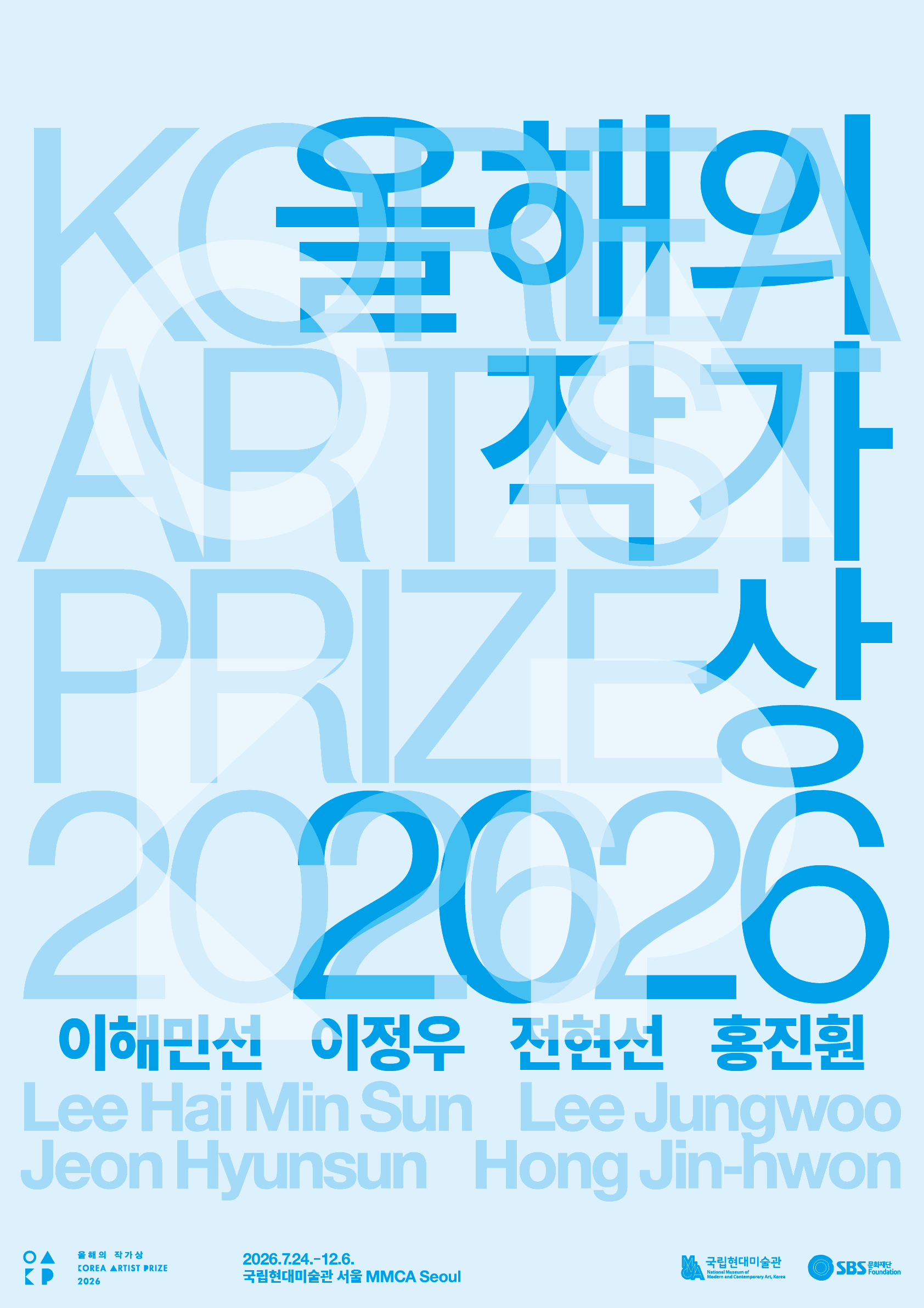
이미지: 전시 포스터. 국립현대미술관 제공.
Admission: 2,000 KRW
The National Museum of Modern and Contemporary Art, Korea (MMCA; Director Kim Sunghee), in collaboration with the SBS Foundation, presents the exhibition Korea Artist Prize 2026 at MMCA Seoul from 24 July to 6 December 2026.
Jointly organized by the MMCA and the SBS Foundation since 2012, the Korea Artist Prize is one of Korea's leading support programs for contemporary artists. Each year, four artists (individuals or teams) are selected to receive funding for the production of new works, the Korea Artist Prize exhibition at the MMCA, and continued support for their international projects.
The four artists selected to participate in Korea Artist Prize 2026—Lee Hai Min Sun, Lee Jungwoo, Jeon Hyunsun, and Hong Jin-hwon—each explore the ways in which we perceive our contemporary world and the conditions under which images are produced through their own specific artistic media and individual methodologies. Although their practices have significant differences, they move beyond focusing purely on representation itself and pursue a common interest in critically delving into the structures and systems shaping our understanding of the world. Through traces of time embedded in disappearing landscapes, histories reconstructed through generative artificial intelligence, painterly spaces within which multiple narratives coexist, and the social and political power embedded within images, these four artists each offer distinct perspectives on some of the most pressing questions of our time.
Lee Hai Min Sun has developed a multidisciplinary practice spanning painting and installation, closely observing the traces of time accumulated in objects and environments as she explores states of being suspended between endurance and disappearance. Her new painting Lingering Snow (2026) focuses on snow that has not yet completely melted, investigating the relationship between absence and lingering trace. Rather than depicting snow itself, Lee accumulates the stains, dust, and signs of melting left behind on the surface of her canvas, evoking forms of existence that are no longer apparent. Additional new works, including Outside (2026) and Plant Erectus_The Mass (2026), examine landscapes shaped by impermanent conditions that unexpectedly endure, as well as relationships between beings that sustain one another. When taken as a whole, these works reveal the temporal and existential conditions that continually operate even within absence.
Lee Jungwoo critically investigates the ways in which generative artificial intelligence (AI) and data-driven technologies construct reality and history, examining both the possibilities and limitations of contemporary technological systems. His new project In Writing "Hurrah for Freedom": Cinema and History (2025–2026) traces histories of censorship, erasure, and distortion while reconstructing missing scenes from the Korean liberation-era film Hurrah for Freedom (1946) using generative AI. Drawing parallels between historical censorship and contemporary online platform regulations, content moderation, and algorithmic bias, Lee questions the evolving relationship between history, technology, and freedom. The Left Handed Gun (2026), a new video installation, further investigates biases embedded within AI video generation models, exposing the limitations of technological systems when interpreting and classifying the world while simultaneously reflecting on image production in the age of AI.
Jeon Hyunsun has reimagined painting as an immersive spatial environment through the interplay of geometric order and narratives of random chance. Her new work, Even Rabbits Dig a Second Burrow (2026), is a large-scale painterly installation composed of 30 canvases. Bringing to mind the appearance of an indoor rock climbing wall, the installation invites visitors to navigate the images by following their own paths, constructing individual perspectives and modes of viewing. Instead of converging toward a single, fixed conclusion, Jeon juxtaposes multiple layers of lived experience within the pictorial field, fashioning an open-ended narrative in which diverse beings, events, and temporalities coexist. Sculptural elements interspersed throughout the gallery expand the paintings into three-dimensional space, as though images have acquired material form and stepped out of their canvases. Together, these paintings and sculptures encourage visitors to move fluidly between two and three dimensions, and image and object, expanding the possibilities of spatial perception.
Hong Jin-hwon has long explored the power dynamics and visual regimes embedded within images through a multidisciplinary practice spanning photography, film, and web programming. His new video work The Highest Form of Image Is Armed Struggle (2026), juxtaposes declarations from revolutionary movements of the past with contemporary protest culture, reflecting on the ways in which social movements are consumed, circulated, and reconfigured as images. The new installations Dark Adaptation (2026) and Light Adaptation (2026) investigate the innate power of contemporary visual systems through the stark contrast of darkness and light, questioning the boundaries between visibility and invisibility, while the photographic series Exactly Speaking, the Milky Way is a Phantom (2026) places images of political landscapes and historical sites side by side to examine the relationships between landscape, memory, and acts of witnessing, suggesting that images have the potential to move beyond their function as records and act as sites within which to contemplate absence and silence.
Through the unique perspectives of four artists who challenge familiar ways of seeing the world, Korea Artist Prize 2026 offers a compelling overview of contemporary artistic practice. Although they work with different media and artistic languages, all four artists share a commitment to questioning the structures and conditions that shape our understanding of the world and laying bare the spaces in which those systems begin to unravel. This exhibition invites visitors to reconsider the relationships between image and memory, history and reality, and humanity and the environment, proffering new avenues for critical reflection through contemporary art.
Press Release: MMCA
Image: Poster, MMCA