전시 소개 ABOUT THE EXHIBITION
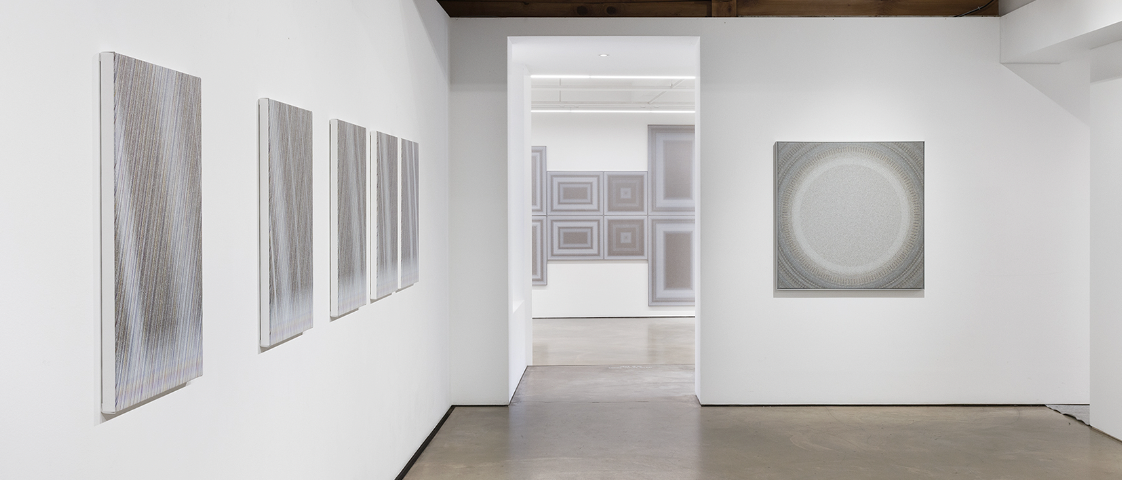
화면 위에 쌓인 층위가 미세한 파동을 일으키며 공간을 채운다. 멈춰 있는 듯하나 끊임없이 움직이고, 단단해 보이지만 어느덧 가벼운 비물질의 상태로 부풀어 오른다.
지근욱의 회화는 이처럼 명료하게 이어지는 선 긋기에서 출발한다. 저마다의 색들로 그어지는 선들은 특정한 형상을 구축하지 않는다. 일정한 방향과 간격을 따라 촘촘하게 메워 나간다. 이 집요한 과정이 독자적인 밀도와 결을 형성하면, 표면에 솟아오른 세밀한 융기는 시각적 진동을 일으킨다. 시선은 더 이상 고정되어 있지 않다. 그 사이를 유영하게 되며, 이미지는 읽히는 대상이 아닌 흔적을 좇는 경험으로 전환된다. 마지막 선이 놓이는 순간, 인과적인 연결은 느슨해지고 평면은 스스로의 운동을 만들어낸다. 미세한 오차와 흔들림은 선형적인 규칙을 해체시켜 화면을 끝내 멈추지 않는 과정의 상태로 남겨둔다. 지나간 움직임과 아직 도래하지 않은 움직임이 한 장면 안에서 겹쳐지듯 감지되어 각기 다른 방향의 시간이 스쳐 지나간다.
이 시간의 흐름은 이번 전시를 관통하는 ‘금속(Metal)’이라는 물질에서 분명해진다. 여기서 금속은 단순히 차가운 질료를 의미하지 않는다. 그것은 수백만 년의 압력과 변성을 견디며 생성되어, 과거와 미래를 동시에 품은 비선형적 상징물이다. 캔버스에 겹겹이 축적된 물질적 흔적은 빛과 만나 반응하고, 화면에 깊은 공명을 일으킨다. 이때 금속성 표면이 발산하는 즉각적인 반사는 내밀하게 스며든 시간의 층위와 대비를 이루며, 평면을 입체적인 구조적 공간으로 탈바꿈시킨다. 마치 먼 과거의 빛을 투영하여 현재로 불러들이는 ‘딥 필드(Deep Field)’처럼, 프레임 속에 갇혀 있던 질료들은 유연하게 흐르기 시작한다. 무게는 중심을 잃고, 고정된 화면은 경계를 넘어 열린 사유의 장으로 확장된다.
응축된 물질이 행위의 반복을 통해 초월적인 상태로 고양될 때, 비로소 ‘날개(Wing)’가 구체적인 형상을 드러낸다. 이때 날개는 중력을 거스르는 장식적 도상이 아니다. 물질이 자신의 조건을 벗어나 확장되는 운동의 형식이다. 금속의 질감은 점차 가벼워지고, 화면 너머의 비가시적인 감각으로 이행하는 통로가 열린다. 그 안에서는 어디서부터 시작되었는지 알 수 없는 시간들이 놓인 채 함께 존재한다. 이는 곧 정신의 본질에 닿으려는 날갯짓이다.
“이미지 앞에 설 때, 우리는 시간 앞에 서 있다.”ㅡ조르주 디디-위베르만(Georges Didi-Huberman)의 통찰처럼, 지근욱의 회화 앞에서 마주하게 되는 것은 고정된 평면이 아닌, 시간의 흔적이다. 미술사적 사유에서 아비 바르부르크(Aby Warburg)는 ‘고대의 잔존(Nachleben der Antike)’이라는 개념을 통해 과거의 형식이 역사 속에서 사멸하지 않고, 다른 시대의 시각문화 속에서 끊임없이 재출현한다고 보았다. 이를 이어받은 디디-위베르만 역시 이미지를 특정한 시기에 고정된 산물이 아니라, 서로 다른 연대(年代)가 어긋난 채 머무는 장소로 정의한다. 일종의 ‘아나크로니즘(Anachronism)’이다. 지근욱은 이 담론을 회화라는 실재하는 감각으로 치환해내는 듯 보인다.
《금속의 날개》는 행위와 물질, 그리고 형태를 갖지 않은 시간들이 한 화면 위에서 교차한다. 그의 회화는 단순히 화면을 채우기 위한 기계적 행위가 아니다. 다른 가능성을 향해 나아가는 실험이자 시도다. 그 사이에서 회화는 다시 하나의 궤적을 그리며 틀을 이탈한다. 아직 규정되지 않은 또 다른 방향을 향해, 비행한다.
- 「시간의 궤적, 물질의 비행」 전시 서문 중 ㅣ 이주연 (학고재 기획 팀장)
자료 출처: 학고재갤러리
전시전경: 학고재갤러리
Layers accumulate on the canvas, and from those layers, fine undulations ripple outward into the surrounding space. What appears still is ceaselessly in motion. What appears solid swells, imperceptibly, into a state of weightless immateriality.
Thus, Keun Wook JI's painting begins in the deliberate, unbroken act of drawing lines. Each line is laid in its own color, yet they do not coalesce into any particular form. Instead, they fill the surface at consistent intervals, following a steady direction, closing the gaps with exacting persistence. When this process has generated its own density and granularity, the surface rises with fine ridges and visual tremor. Upon meeting those ridges, the gaze is no longer fixed; it drifts among the intervals, and the image shifts from the object of experience into a quest of interrogating traces. With the placement of the final line, causal links become listless and the flat surface of the canvas spawns its own motility. Minute deviations and undulations dismantle the mandate of linearity, suspending the canvas in perpetual liminality, never quite reaching a fixed state. Motions past and not yet arrived overlap and interlace on a single frame, allowing the divergent currents of time to brush past one another.
This temporal flux anchors itself in the core material of this exhibition: metal. Yet, metal here is no mere cold, inert substrate. It is an emblem of non-linearity, forged by aeons of pressure and metamorphosis, holding both the ancient past and future time. The stratified material traces on the canvas respond to light, drawing deep echoes from the picture plane. The immediate reflections cast by the metallic surface form a counterpoint to the intimately sedimented strata of time beneath them, and this tension between the instantaneous and the ancient transforms the flat plane into a space of structural depth. Comparable to the Hubble Deep Field, which anneals the light of a primordial past into the present, the weight of the substrates once confined within the frame begins to yield and effuse. Weight loses its anchor, and the rigid surface gives way to an open, boundless field of thought.
When this condensed matter is pushed to a transcendent state through rhythmic repetition, the wing finally takes shape. This wing is no decorative symbol of defiance against gravity; rather, it is the shape of matter exceeding its own conditions. The texture of metal grows lighter, and a threshold opens to a sense beyond the visible surface. Within this space, times of unknown origin converge and coexist. It is the beating of wings in flight toward the essence of spirit.
"Whenever we are before the image, we are before time." As French philosopher and art historian Georges Didi-Huberman observed, what we encounter before JI's paintings is not a fixed plane, but the trace of time. Within art historical discourse, German art historian and cultural theorist Aby Warburg captured this restless collision of eras when he declared, “Athens has constantly to be won back again from Alexandria.” Through this concept of Nachleben der Antike (the afterlife of antiquity), Warburg defined how past forms do not perish in history, but constantly reincarnate and resurface in the visual culture of later eras. Expanding on this, Didi-Huberman views the image not as a frozen artifact, but as a restless site where discordant timelines overlap: an anachronism of sorts. Keun Wook JI acts as a visual alchemist, transmuting this theoretical discourse into the material, tangible sense of painting.
In Keun Wook JI’s exhibition Metallic Wings, physical practice, substrate matter, and formless time intersect on a single surface. His paintings are not a mechanical raster, sweeping to fill a surface. They are a crucible testing other possibilities. In the space between, his traces depart from their own boundaries. Forged in metal yet bound for the sky, they take flight toward a direction not yet defined.
- Excerpt from 「Temporal Trajectory, Material Flight」 l Juyeon Lee (Hakgojae Gallery, Exhibition Manager)
Press Release: Hakgojae Gallery
Installation View: Hakgojae Gallery