전시 소개 ABOUT THE EXHIBITION
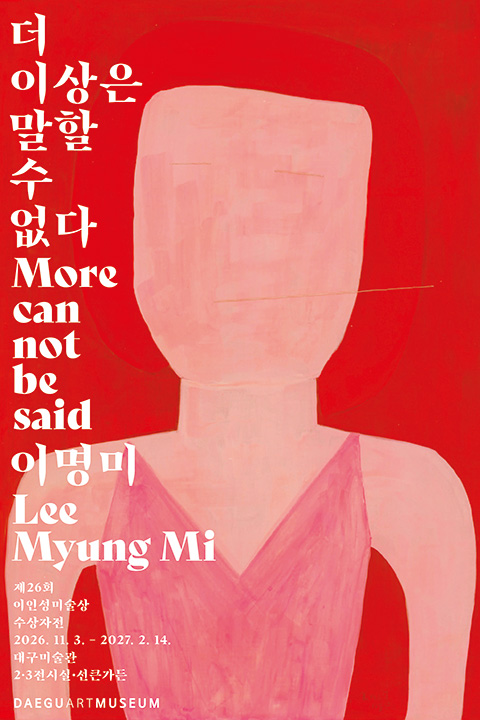
제26회 이인성미술상 수상자전 《이명미: 더 이상은 말할 수 없다》는 2025년 수상자로 선정된 이명미(1950-)의 수상을 기념하는 전시이다. 그는 한국 현대미술의 1세대 여성 작가로서 1970년대 단색화의 주류 흐름에 편승하기보다 다양한 색의 실험과 일상의 '놀이' 개념을 중심으로 자신만의 회화 언어를 펼쳐 왔다.
이번 전시는 1970년대부터 현재에 이르기까지 50여 년에 걸친 이명미의 화업을 폭넓게 아우른다. 그의 작업에서 '놀이'는 개인과 일상, 나아가 세계를 바라보는 작가의 태도와 맞닿아 있으며, 그 기저에는 삶 속에 존재하는 다양한 '관계'가 놓여 있다. 작가이자 한 가정의 어머니, 그리고 사회의 일원으로 살아온 삶의 단편들은 예술과 분리된 사적인 영역이 아니라 그의 회화와 긴밀하게 영향을 주고받는다. 또한 '놀이' 작업은 우리가 당연하다고 믿어 온 삶과 일상, 나아가 세계의 질서를 의심하고 낯선 방식으로 다시 탐색하게 한다.
전시 제목 《더 이상은 말할 수 없다》는 언어로 다 설명되지 않는 수많은 관계의 세계를 보여 주는 이명미의 작업을 함축한다. 이는 침묵이 아니라, 진정한 소통을 위해 모든 것을 열어 두겠다는 고백이다. 50년 화업의 변화와 작가가 지나온 삶의 시공간을 담은 이 제목은, 작업 뒤에 숨은 의미를 각자 어떻게 읽어 낼 것인지 보는 이에게 묻는다.
전시에서는 지금까지 공개되지 않았던 초기 작업을 비롯해 회화와 오브제 작업, 아카이브 등 다양한 자료를 선보이며, 작품 너머에 놓인 작가의 실험과 기억, 삶의 흔적을 입체적으로 조명한다. 이를 통해 일상의 생동감이 오늘날 우리에게 어떤 감각으로 다가오는지, 그리고 그것이 어떻게 회화의 동시대성을 만들어 내는지 살펴볼 수 있을 것이다. 일상 사이에 놓인 수많은 관계를 자유롭게 넘나드는 그의 화면처럼, 이번 전시가 우리가 당연하게 지나쳐 온 세계를 새로운 시선으로 바라보고 그 안에 숨은 또 다른 이야기들과 만나는 자리가 되기를 기대한다.
전시는 4개 섹션으로 구성되며, 1~3섹션은 연대순으로 작가의 발자취를 따라간다. 첫 번째 섹션 [표현하지 않는 그림: 연기에서 놀이로]에서는 초기 작품을, 두 번째 섹션 [삶의 놀이: 여자·남자·아이]에서는 관계에 의해 벌어지는 삶의 서사를 담는다. 세 번째 섹션 [춤추는 글자, 노래하는 그림]에서는 대중가요의 제목이나 가사를 빌려 언어와 시각 기호를 자유롭게 넘나드는 작품 세계가 펼쳐진다. 네 번째 섹션 [경계의 세계: 놀이/터]에서는 작가의 유머와 통찰을 창문 형태의 공간에서 재구성하였다. 말이나 표현으로 미처 다할 수 없는 것들의 의미를 되새기며 관람객과 소통한다. 마지막으로 선큰가든 [Into the Sun]에서는 BTS의 동명 노래에서 영감을 받은 〈Into the Sun〉(2026)을 비롯해 대작 14점과 소품 200여 점을 선보인다. 햇빛이 가득한 공간에서 우리가 미처 의식하지 못했던 일상을 새롭게 마주해 보기를 제안한다.
The 26th LEEINSUNG Art Prize Recipient Exhibition, Lee Myungmi: More Cannot Be Said, celebrates Lee Myungmi's selection as the 2025 prize recipient. As one of the first generation of women artists in Korean contemporary art, Lee has pursued her own painterly language through experiments with a wide range of colors and the concept of “play” in everyday life, rather than following the dominant current of Dansaekhwa (Korean monochrome painting) in the 1970s.
This exhibition offers a broad view of Lee’s artistic practice over more than fifty years, from the 1970s to the present. In her work, “play” is closely connected to her outlook on individuals, everyday life, and the wider world. Underlying it are the many relationships that constitute a life. Fragments of her life as an artist, a mother, and a member of society do not belong to a private realm separate from art; they continually shape, and are shaped by, her painting. Her explorations of play also prompt us to question the order we take for granted in life, in our daily routines, and in the world at large, and to explore it anew in unfamiliar ways.
The exhibition title, More Cannot Be Said, encapsulates Lee’s exploration of a world of countless relationships that language cannot fully describe. Rather than signaling silence, it expresses a willingness to leave all possibilities open for genuine communication. Encompassing the changes in her painting over fifty years and the times and places through which she has lived, the title asks how each viewer might read the meanings that lie behind her work.
The exhibition brings together previously unseen early works, paintings, object-based works, and archival materials, offering a multifaceted view of the artist’s experiments, memories, and traces of life that lie beyond the works themselves. It invites us to consider how the vitality of everyday life speaks to our senses today, and how it gives painting its contemporary resonance. Just as Lee’s paintings move freely among the countless relationships woven through daily life, we hope this exhibition offers a space in which to look anew at the world we have so often taken for granted, and to encounter the other stories hidden within it.