전시 소개 ABOUT THE EXHIBITION
변신, 되기의 시간
변신은 흔히 한순간에 일어나는 사건처럼 여겨집니다. 눈앞의 모습이 갑자기 달라지고 전혀 다른 존재가 나타나는 순간에는 늘 강렬한 매혹이 따릅니다. 그러나 그러한 변화가 가능해지기까지는 긴 시간과 사유, 그리고 물질 앞에서 기꺼이 머무르려는 태도가 필요합니다. 몸의 안과 밖을 가로지르는 구조와 감각을 더듬고, 물질의 반응을 시험하며, 하나에서 다음으로 이어지는 연쇄를 감수하는 시간이 축적됩니다.
어릴 때 우리는 다른 무엇이 되는 일에 더 열려 있었습니다. 천 한 장을 걸치면 몸의 윤곽은 곧장 달라졌고, 팔을 뻗거나 몸을 구부리는 것만으로도 지금의 내가 아닌 다른 몸을 상상할 수 있었습니다. 몸의 경계는 피부에서 끝나지 않았고, 주변의 사물과 물질은 쉽게 신체의 일부로 스며들었습니다. 시간이 흐르면서 우리는 몸을 하나의 고정된 형태로 이해했고, 사물에 제자리를 부여하고 분류했습니다. 조각 역시 완결된 형상으로 인식되었습니다. 그러나 형상이란 본래 물질과 감각, 지지의 조건이 특정한 방식으로 만날 때 비로소 성립하며, 그 조건이 달라지면 형상 역시 다르게 구성될 수 있습니다.
2026년 인천아트플랫폼 기획전시 《변신 연습》은 동시대 조각을 중심으로, 형상이 물질과 감각의 조건 사이를 이동하며 다른 존재일 수 있는 가능성을 탐색합니다. 이 전시는 몸과 사물, 이미지와 매체를 가로질러 존재의 위상 자체가 이동하는 경험과 그 과정을 '변신 연습'이라 부릅니다. 변신을 형상과 제작, 감각의 조건이 드러나는 자리에서 지속되는 연습의 시간으로 이해합니다. '변신'이 한 존재가 다른 조건 속에서 나타날 수 있다는 가능성의 이름이라면, '연습'은 그 가능성이 단번에 실현되지 않는다는 사실을 받아들이는 데서 시작됩니다. 연습은 완결을 유예한 채 같은 동작을 반복하고, 몸과 물질의 반응을 감각하며, 아직 도달하지 않은 형상을 향해 조건을 고쳐 나가는 시간입니다.
참여 작가 곽인탄, 안태원, 우한나, 이형구는 서로 다른 물질적·시간적 조건 속에서 형상이 어떻게 성립하는지를 다시 묻고, 그 성립의 조건 자체를 각기 다른 방식으로 변형하며 물질과 감각, 제작 행위의 관계를 시험합니다. 가상에 물질적 조건을 부여하는 상상과 신체의 안과 밖을 가로지르며 경계를 다시 그리는 실천, 비가시적인 것을 감각하고 체화하려는 시도, 창작을 완결이 아닌 열린 과정으로 전환하는 태도는 '다르게 구성될 수 있는 가능성'이라는 질문 앞에서 교차하고 상통합니다.
이형구는 존재하지 않는 몸에 해부학과 분류학의 체계를 부여하며, 가상의 존재가 현실의 질서 안에서 하나의 신체로 성립되는 조건을 구축합니다. 또한 자신의 몸에 낯선 종의 운동학을 이식하는 반복적인 수행을 통해 감각의 구조가 재편되는 과정을 드러냅니다. 이러한 작업은 무엇이 존재로 승인되는지를 되묻는 동시에, 몸이 다른 방식으로 작동할 수 있는 조건을 제시합니다.
우한나는 신체 안에 잠재한 에너지를 패브릭을 매개로 바깥의 형태로 끌어냅니다. 보호와 은신, 노출의 감각을 동시에 품은 패브릭이 착용 가능한 외피가 될 때, 입는 행위는 몸의 경계를 다시 구성하는 방식이 됩니다. 바느질되고 접히고 매달리는 천은 피부이자 장막이며 하나의 기관으로 작동합니다. 우한나의 조각은 접히고 늘어지며 몸과 함께 움직이는 유연한 구조를 이룹니다.
안태원은 이미지와 물질이 만나는 접면에서 감각의 불일치를 다룹니다. 친밀한 존재의 감각과 네트워크를 통해 유통되는 이미지의 감각을 하나의 표면 위에 겹쳐 놓습니다. 체온과 촉각을 지닌 대상은 스캔과 변형을 거치며 이미지의 흐름으로 들어가지만, 물질 위에 놓이는 순간 그 감각은 완전히 일치하지 않은 채 남습니다. 두 감각은 포개지지 않은 상태로 어긋나며, 작가는 그 어긋남을 새로운 형상의 조건으로 삼습니다.
곽인탄은 하나의 조각이 다음 조각으로 이어지는 연쇄적 생성의 흐름을 만듭니다. 제작 과정에서 남겨진 파편과 잔여는 다시 다음 작업의 재료가 되며, 함께 만드는 시간 속에서 여러 사람의 손이 개입하는 열린 구조를 통해 조각의 범위를 확장합니다. 놀이와 제작이 맞물리는 지점에서 조각이 어디까지 열려 있을 수 있는지를 실험합니다.
변형된 형상은 존재의 새로운 층위를 열어 보이며, 우리가 익숙하게 받아들여 온 몸과 형상의 질서를 다시 묻습니다. 오랜 수행의 시간이 응축된 작업 사이를 걸으며 가변적이고 임시적인 감각의 지대를 통과합니다. 일부 작업은 앉고, 걸치고, 함께 만드는 행위를 통해 각자의 방식으로 변신의 감각을 마주하게 합니다. 변신 연습은 지금, 이곳에서 계속됩니다.
자료 출처: 인천아트플랫폼
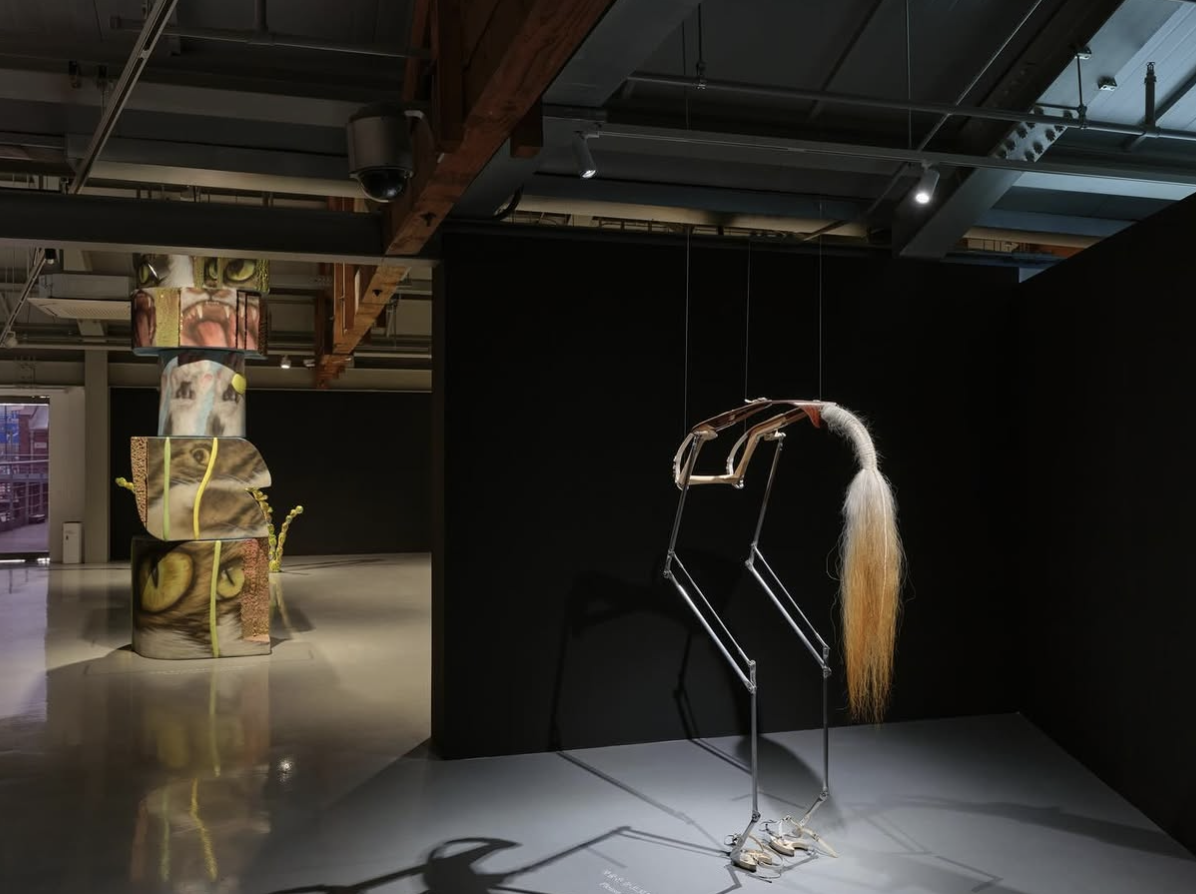
전시전경: 인천아트플랫폼
Transformation: A Time of Becoming
We often regard transformation as something that happens in an instant. There is always a powerful fascination we feel in moments when something before us suddenly changes and a completely different presence reveals itself. But for such changes to become possible, we need a lot of time and contemplation, along with a willingness to remain in the presence of something substantial. It is an accumulation of moments when we refine structures and senses within and outside the body, test the substance’s response, and accept the sequences that lead from one thing to another.
As children, we were much more open to becoming something else. Simply placing a piece of fabric over our body was enough to change its contours, and by stretching out our arms or bending, we could imagine a different body besides our own. The body did not stop at our skin; surrounding objects and substances could easily become part of it. As time passed, we began understanding the body as a fixed form and assigning places and categories to objects. Sculptures likewise came to be understood as completed forms. But form is something that comes to be when matter is organized in a certain way and the senses interpret it as the appearance of something. Those forms may be composed differently as the arrangements and conditions of perception change.
The 2026 Incheon Art Platform special exhibition Rehearsing Transformation focuses on contemporary sculpture as it examines the process of forms shifting between differing material and sensory conditions and shows the potential to become a different presence entirely. It uses the term “rehearsing transformation” to describe an experience and process in which the very state of being shifts across the body, objects, images, and media. If “transformation” means the possibility of one presence manifesting under different conditions, “rehearsing” starts with us accepting that this possibility is not realized all at once. Rehearsal is a period of repeating the same movement without a completed outcome, sensing the reactions of the body and matter while adjusting the conditions toward something that has yet to arrive.
The featured artists—KWAK Intan, AHN Taewon, WOO Hannah, and LEE Hyungkoo—reorganize the ways in which forms manifest in different material and temporal contexts, constantly testing the relationships that exist among substance, perception, and production. Their approaches involve imagining ways of assigning material conditions to fictional things; practicing the redrawing of boundaries between the body’s interior and exterior; attempting to perceive and internalize the invisible; and turning creation into an open-ended process rather than a “completion.” All of these intersect and connect around the question of how things might be differently composed.
LEE Hyungkoo applies anatomical and taxonomic systems to nonexistent bodies, creating a context where fictional forms come to stand as bodies in the real-world order. He also shows the process of sensory structures rearranging through a repeated performance in which the kinematics of foreign species are transplanted into his body. In addition to raising questions about what is recognized as “being,” his work suggests concrete conditions for the body to operate in different ways.
WOO Hannah uses fabric as a medium to draw the potential energy inside the body into an outward form. Fabric harbors senses of protection, concealment, and exposure, and when it becomes a wearable covering, it offers a way to redefine the body’s boundaries through the act of wearing. As it is stitched, folded, and suspended, it operates at once as a skin, a curtain, and an organ. Woo’s sculptures create flexible structures that fold, stretch, and move with the body.
AHN Taewon focuses on the deviations that arise in the senses where images and substance come together. On a single surface, he overlaps the perceptions of familiar presences with those of images circulated over networks. Things that possess warmth and tactility enter a flow of images through processes of scanning and transformation, but when they appear in a material setting, the perceptions appear in ways that do not fully align. The two perceptions linger without overlapping, and it is this misalignment that the artist uses as a foundation for new forms.
KWAK Intan creates serial flows of generation where one sculptural form leads to another. Reusing the fragments and residues of his production process as materials for the next sculpture, he opens up structures where multiple hands are involved in an experience of co-creation. He experiments with the question of how open a medium sculpture can be where play and creation come together.
These transformed shapes open different layers of being, posing new questions about the familiar and accepted order of the body and form. Visitors to the gallery will pass through a realm of variable, temporary perceptions as they walk among works that distill long experiences of execution. Some of those works invite the viewer to experience the sense of transformation through their own acts of sitting, wearing, and co-creating. The process of “rehearsing transformation” continues here and now.
Press Release: Incheon Art Platform
Installation View: Incheon Art Platform