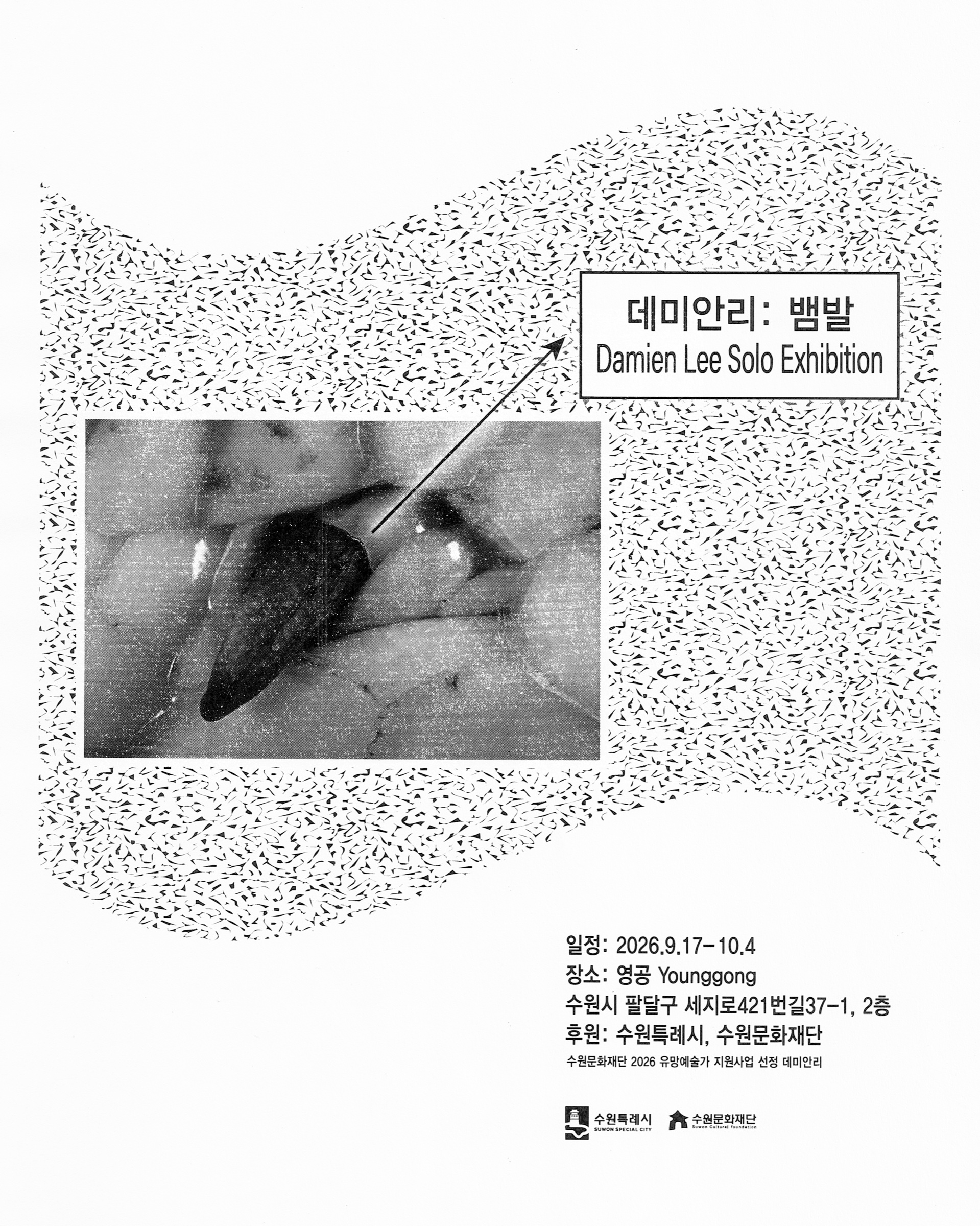
전시 소개 ABOUT THE EXHIBITION
작가와의 대화: 2026. 9. 20.(일) 19:30–20:30 — 데미안 리, 갈로아
뱀발 (사족 蛇足)
“뱀의 발”이라는 뜻으로, 쓸데없는 것을 덧붙여 도리어 그것을 망치는 짓을 의미한다.
다수가 동의하는 가치에 불필요한 것들, 사회는 뱀발이 사라진 과정처럼 서서히 사족을 잘라내며 매끈하고 세련된 쪽을 향한다. 이러한 기조에 따라 우리는 누구나 사족을 자르는 순간들을 지나 세련된 사회의 일원으로 뱀의 머리로 나아간다. 내가 기억하는 첫번째 순간은 유년시절 자주 들은 “사람이 되어라”는 훈계로 인지된 사람다운 것에 어울리지 않는 사족,
십대에는 가부장적 환경에서 요구되는 사내답기에 대한 사족을 잘라내고,
이국에서는 외국인으로서 집단의 훌륭한 구성원 되기에 대한 사족을 잘라내려 애썼다.
그리고 최근까지 미술가다운 것의 사족을 잘라내려 고민하였으니,
일생을 뱀발 자르기에 몰두하였다고 볼 수 있다.
그렇다면 사라진 뱀발은 어디로 갔을까?
연구에 따르면 뱀의 다리는 진화 과정에서 크게 축소—소실되었지만, 다리 발생에 관여하는 유전적 프로그램은 여전히 남아 있다. 일례로 2016년 발표된 연구에서는 비단뱀의 배아형성 과정에서 다리가 될 조직이 일정부분 발달하다 멈추는 것을 확인하였는데 이를 통해 뱀의 다리가 부재가 아닌 중단 상태에 가까운 것임을 밝힌다.
그간 잘라내던 사족 또한 외부로 드러나지 않을 뿐 언제든 뻗을 수 있는 상태로 내재되어 꿈틀거리는 성장통을 안겨줬다. 이를테면 “미술가다운 것”과는 거리가 먼 뱀발에 대한 구구절절한 자료와 이미지를 수집하고 기억해 온 일 자체가 무척이나 사족이 아닌가. 그러나 동시에 이러한 사족들에 가장 내밀한 자아가 깃들어 있음을 믿는데, 우리는 모두 한때 세상에 대한 무수한 질문들로 자아를 형성하지 않았나.
눈앞의 것을 정보로 환원해 정의하고 분류하는 일은 세련되고 합리적이지만, 때로는 주관적인 의문과 상상이 뻗어 나갈 경로를 제한한다. 그러므로 다수가 동의할 만한 가치도 아니며, 설명이 어렵고, 명확한 정의도 붙지않는 무질서를 뱀발로 걸어가며 숨겼던 호기심을 마음껏 누려보자. 의문하거나 상상하지 않는 매끈한 구조의 일부에서 다시금 투박한 개인이 되기에는 사족의 각력(脚力)이 필요하다. 미뤄 둔 성장통을 겪겠지만, 그렇게 걸어 나가는 방향은 비단 뱀의 머리만은 아닐 것이다.
Artist Talk: September 20, 2026, 7:30pm–8:30pm — Damien Lee and Galois
Snake Legs (sajok 蛇足)
Literally meaning “a snake’s legs,” the expression refers to adding something unnecessary and thereby spoiling the whole.
Those things that are deemed unnecessary to values shared by the majority: as with the evolutionary disappearance of snakes’ legs, society gradually cuts away its superfluities and moves toward what is smooth and refined. Following this tendency, we all pass through moments of cutting away our own excesses and advance toward becoming polished members of society—the snake’s head. The first such moment I remember came in childhood, when the admonition “become a person” made me recognize the appendages that did not fit what was considered properly human. In my teens, I cut away what did not conform to the masculinity demanded by a patriarchal environment. Abroad, I tried to remove what kept me from becoming an exemplary member of a collective. Until recently, I agonized over cutting away what seemed unbecoming of an artist. It may be said that I have spent my life cutting off snake legs.
Then where did those vanished legs go?
Research shows that while snakes’ legs were greatly reduced and lost through evolution, the genetic programs involved in limb development remain. A 2016 study, for example, found that during python embryogenesis, tissues destined to become legs develop to a certain point and then stop—suggesting that snakes’ legs are not so much absent as arrested.
The superfluities I had cut away were likewise only hidden from view. They remained within me, poised to extend at any time, producing the writhing growing pains of development. Is not the very act of collecting and remembering endless materials and images about snake legs—things far removed from what is considered “artist-like”—itself thoroughly superfluous? Yet I also believe that our most intimate selves dwell in these appendages. Did we not all once form our identities through countless questions about the world?
Reducing what lies before us to information, defining and classifying it, may be polished and rational, but it sometimes restricts the paths along which subjective doubt and imagination can extend. Let us therefore walk through disorder on snake legs—disorder that has no broadly agreed value, is difficult to explain, and resists clear definition—and freely enjoy the curiosity we once concealed. To become rough-edged individuals again within a smooth structure that neither questions nor imagines, we need the strength of those superfluous legs. We may undergo the growing pains we postponed, but the direction in which we walk will not lead only to the snake’s head.